 Cameroonian · Main Dishes
🥬 Kwa'Ndzap (Pounded Cocoyam Balls with Sautéed Nightshade Leaves, N'dzap)
Kwa'Ndzap (balls: Kwa'a; leaf mixture: N'dzap)
Boiled cocoyam pounded into smooth balls, served with nightshade leaves boiled with limestone and stir-fried with tomato, onion, leek, basil, white pepper and crushed dried shrimps.
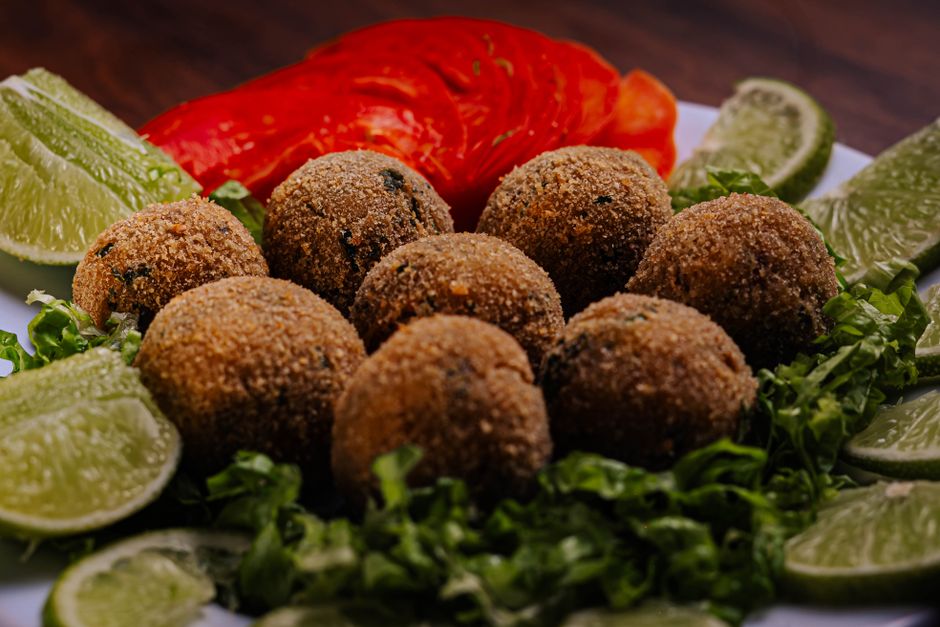
Cocoyam is boiled 30 to 45 minutes, pounded hot to a smooth paste and shaped into small balls called Kwa'a. Nightshade leaves are boiled in 1.5 liters of water with limestone, rinsed, then fried 5 minutes with a chopped tomato, onion, leek and basil mixture and simmered 20 minutes with white pepper and a little crushed dried shrimp.
Ingredients
Equipment: Large pot, Mortar and pestle, Spatula, Frying pan or pot, Sieve
Kwa'a (cocoyam balls)
- cocoyam tubers
N'dzap (nightshade leaves)
- 4 bunches nightshade leaves
- 1 g of limestone
- 4 – 5 large tomatoes
- 2 large onions
- 1 clove garlic, 1 small piece ginger, 2 yellow peppers
- 1 large leek
- 1 basil branch
- 1/4 liter refined vegetable oil
- 15 - 20 grains white pepper
- Dried shrimps
- Seasoning (stock cubes, salt, pepper)
Method
- Peel the cocoyam and boil it in water for 30 to 45 minutes.
- Pound the hot cocoyam in a mortar to a smooth paste and shape small balls with a spatula; these are the Kwa'a.
- Sort, wash and chop the nightshade leaves. Boil them in 1.5 liters of water with the limestone, drain, and rinse in cool water.
- Finely chop the tomatoes, onions, garlic, ginger, yellow peppers, leek and basil. Fry the mixture in the oil for 5 minutes, then stir-fry the cooked leaves with it.
- Season with salt and the white pepper, crush the dried shrimps and add a little. Simmer on low heat for 20 minutes and adjust the seasoning.
- Serve the balls with the N'dzap and eat with the fingers; one pass also says it may be served with sautéed cabbage.
Chef Tips
- Printed times: cocoyam boil 30 to 45 minutes; fry 5 minutes; simmer 20 minutes. No doneness cues beyond the pounded paste being smooth.
- FLAG: no quantity is printed for the cocoyam tubers or the dried shrimps (the page says only crush the shrimps and add a little).
- The limestone is printed as a plain ingredient with no safety statement. (our note) Check that any limestone you use is sold for eating.
- Pass 1 had the 5-minute fry as the chopped mixture alone before the leaves go in; pass 2 was shorter on this step.
Common Mistakes to Avoid
- Pounding the cocoyam after it has cooled, so it will not form a smooth paste (our note).
- Skipping the cool-water rinse of the boiled leaves (the page rinses them after draining).
Nutrition (per serving)
Health Benefits
- Cocoyam supplies starch for energy; nightshade leaves add leafy greens.
- Dried shrimp adds protein.
Cultural Note
The booklet calls it "a typical dish of the Dschang people, a Bamiléké ethnic group from west region of Cameroon" and says it is eaten with the fingers.
Storage & Serving
Storage: No storage guidance printed.
Reheating: Reheat the leaf mixture gently on the stove (our note).
Serve with: Sautéed cabbage (page, one pass)
Adapted From
- Adapted from "Kwa'Ndzap" (booklet p. 27), "Traditional Vegetables: Recipes from Cameroon", AVRDC - The World Vegetable Center, Shanhua, Tainan, Taiwan, Publication 14-779. BYLINE AS PRINTED: "Takemore Chagomoka, Regine Kamga, Abdou Tenkouano, Maureen Mecozzi". Date as printed: (c) 2014. Book statement: "All recipes provide six servings"; no prep or total time is printed. The authors' own background is not printed on the pages read; the foreword (Regine Kamga) says the project was funded by CORAF/WECARD to promote traditional African leafy vegetables, and the introduction says the recipes are "passed on from generation to generation." URL: https://nutritionconnect.org/sites/default/files/2021-02/eb0217_Traditional%20vegetables%20recipes%20from%20Cameroon.pdf Quoted headnote: "This is a typical dish of the Dschang people, a Bamiléké ethnic group from west region of Cameroon."
- SOURCING STATUS: TWO-PASS, ingredient lines as relayed by a research tool and to be checked against the live booklet; method wording is our own summary; the prep/cook split and nutrition are our own estimates unless the booklet prints them.
- FLAG: no quantity is printed for the cocoyam or the dried shrimps; limestone is listed with no safety statement; the six servings come from the book's general statement, not from this page.