 Ghanaian · Soups & Stews
🥘 Groundnut Stew, Adapted
Nkantenkwan
A declared adaptation with a full cup of peanut butter and both palm oil and a marinade — reduce the liquid by one third, stirring every fifteen minutes.
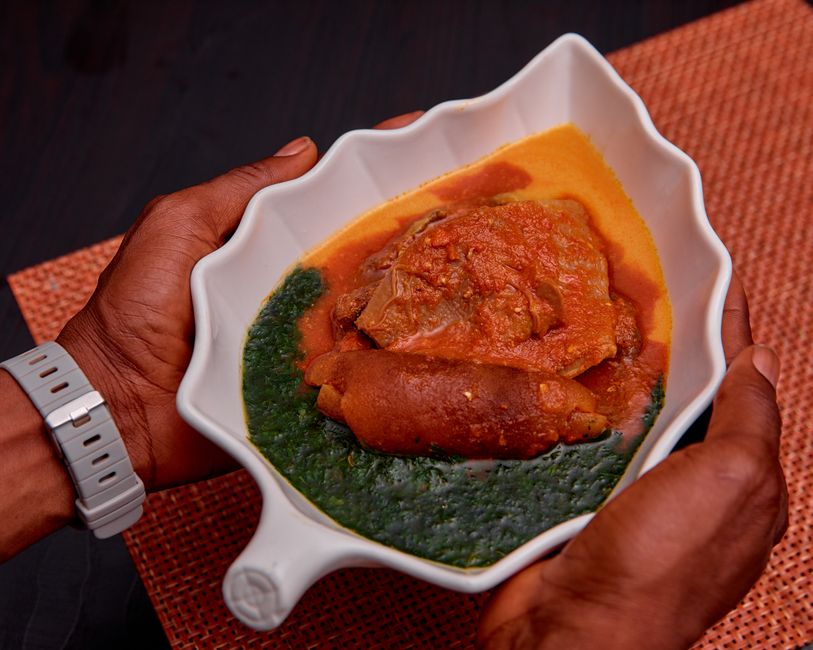
This is a food historian's version and he says plainly it is his own way, written after eating the dish at a chop bar in Kumasi. The chicken is marinated with quartered red onion, smashed garlic, a ginger knob, a hot pepper, a stock cube, tomato paste and oil, then sautéed twenty minutes. Palm oil, broth, a full cup of unsweetened peanut butter, tomatoes, bay leaves and thyme go in, and the whole thing simmers forty-five minutes on low, stirred every fifteen minutes, until the liquid has reduced by one third. The cup of peanut butter makes this the thickest documented version.
Ingredients
Equipment: Heavy pot or Dutch oven, Mixing bowl, Wooden spoon
Marinade
- 2 lb boneless chicken breasts, or bone-in thighs and legs
- 1 large red onion, quartered
- 4 garlic cloves, smashed
- 2 inch ginger knob
- 1 small fresh hot pepper
- 1 stock cube, or 2 tsp powdered broth
- 1 tsp coarse black pepper
- 2 tbsp tomato paste
- 2 tbsp vegetable oil
Stew
- 2 tbsp palm oil
- 2 cups vegetable or beef broth
- 1 cup unsweetened peanut butter
- 2 large chopped tomatoes, or a 28 oz tin
- 2-3 bay leaves
- 2-3 thyme sprigs
Method
- Combine the marinade ingredients with the chicken.
- Sauté the chicken 20 minutes.
- Add the palm oil, broth, peanut butter, tomatoes, bay leaves and thyme.
- Simmer 45 minutes on low, stirring every 15 minutes.
- The liquid should reduce by one third.
- If using any optional umami additions, cook 10 minutes more.
- Serve with fufu or rice.
Chef Tips
- A full cup of peanut butter to two pounds of chicken is the richest documented ratio — roughly double the leanest. Expect a stew you can stand a spoon in, not a soup.
- Reduced by one third is the cue, and it is the only documented groundnut soup that gives a volume endpoint rather than an oil-separation one.
- Stir every fifteen minutes, which the author specifies. At this peanut concentration it will catch on the base otherwise.
- Both palm oil and vegetable oil are used, in the stew and the marinade respectively. The palm oil is for colour and flavour rather than cooking.
- Bay leaves and thyme are this author's additions and are not part of traditional nkatenkwan. Leave them out if you want the Ghanaian version.
- It is a declared adaptation — 'My Way' is in the title — and the headnote credits a chop bar in Kumasi as the original. Treat it as a documented diaspora interpretation rather than a Ghanaian recipe.
- His yield note is worth repeating as published: serves four to six, or two Ghanaians.
Common Mistakes to Avoid
- Treating this as a traditional recipe rather than the declared adaptation it is.
- Skipping the fifteen-minute stirring intervals.
- Leaving out the marinade stage.
- Using sweetened peanut butter.
- Stopping before the liquid has reduced by a third.
Nutrition (per serving)
Health Benefits
- Peanuts supply monounsaturated fat, niacin, folate and vitamin E.
- Red palm oil contributes provitamin-A carotenoids.
- Very high in protein.
- Thyme and bay both carry antioxidant compounds, non-traditional though they are here.
Cultural Note
A named food historian publishing his own version and labelling it as such is the honest way to adapt a dish, and it makes the recipe more useful rather than less — you can see exactly where he departed. The yield note, serves four to six or two Ghanaians, is also the best joke in the source material for this country.
Storage & Serving
Storage: 4 days refrigerated, 3 months frozen.
Reheating: Low heat with broth or water to loosen. It thickens considerably when cold.
Adapted From
- Adapted from 'Groundnut Stew My Way', byline as printed 'michaelwtwitty', afroculinaria.com, 26 March 2018. The author is the food historian Michael W. Twitty; the byline prints as his username. Yield as printed: 'Serves 4-6 (or 2 Ghanaians)'.
- AUTHOR-DECLARED ADAPTATION, and published as one: 'My Way' is in the title. The headnote frames the dish as Akan, cites the spelling 'nkantenkwan', and credits a visit to 'Cece's chop bar in Kumasi'. It is a documented diaspora interpretation by a named food historian rather than a traditional Ghanaian recipe, and is filed as such.
- Ingredients exactly as printed. Marinade: 2 pounds boneless chicken breasts or bone-in thighs/legs; 1 large red onion, quartered; 4 garlic cloves, smashed; 2-inch ginger knob; 1 small fresh hot pepper; 1 Maggi cube (or 2 teaspoons powdered broth); 1 teaspoon coarse black pepper; 2 tablespoons tomato paste; 2 tablespoons vegetable oil. Stew: 2 tablespoons palm oil; 2 cups vegetable or beef broth; 1 cup unsweetened peanut butter; 2 large chopped tomatoes (or 28-ounce can); 2-3 bay leaves; 2-3 thyme sprigs.
- Method as printed: sauté the chicken 20 minutes; add the rest and simmer 45 minutes on low, stirring every 15 minutes. DONENESS CUE as printed: 'Liquid should reduce by one-third.' Optional umami additions get 10 further minutes.
- THE ENDPOINT IS DIFFERENT IN KIND from the other documented groundnut soups, and that is recorded rather than harmonised: this recipe gives a VOLUME reduction (one third) where Adjonyoh, Atadika and the Mama Juliet version all give OIL SEPARATION. Neither is corrected toward the other.
- NON-TRADITIONAL ADDITIONS, flagged: bay leaves and thyme sprigs. Neither appears in any other documented version of this dish.
- PEANUT RATIO POSITION: 1 cup peanut butter to 2 lb chicken is the richest of the six documented versions, against ⅔ cup to a whole chicken at the leanest. For the full spread see the sources at Groundnut Soup with Chicken.