 Ghanaian · Swallows & Staples
🥣 Tuo Zaafe
Tuo zaafi — TZ, tee zed
Learnt in Tamale — three cups of boiling water, three cups of millet flour and three to four cups of cold water, with the grain fermented or not.
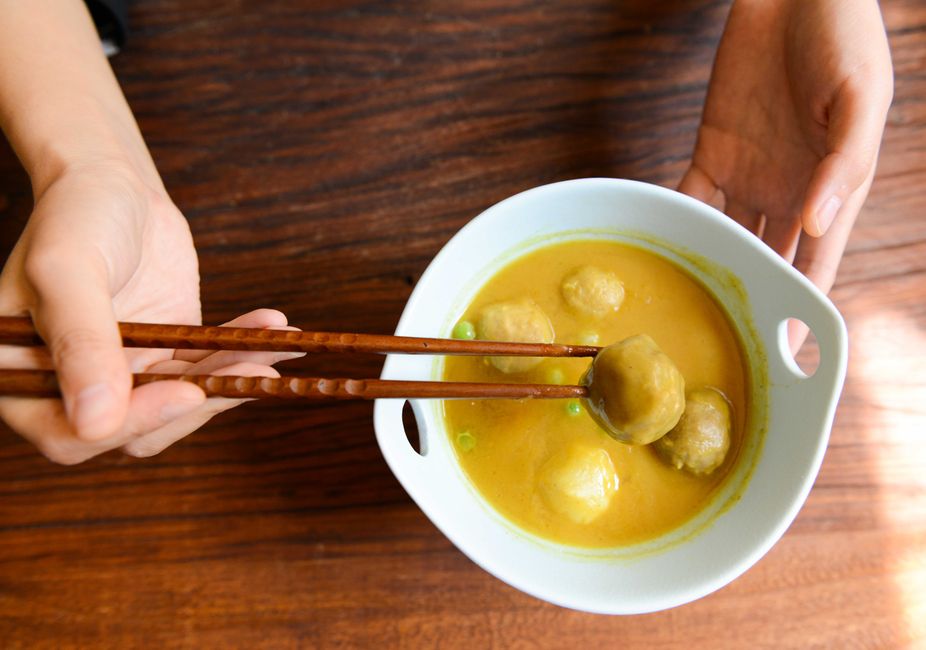
Tuo zaafi is the northern staple, commonly called TZ and literally meaning very hot. This version was shown to the author in Tamale by Mrs Comfort Awu Akor and her daughter, alongside a sesame soup to go with it. The original was made from fonio; the published adaptation uses gluten-free millet flour. Three cups of water come to the boil; meanwhile two cups of cold water are mixed with two cups of millet flour; when the water boils the heat drops to medium and the slurry is quickly mixed in. On the fermentation question the source is admirably brief: the grain can be fermented or not.
Ingredients
Equipment: Heavy saucepan with a handle, Strong wooden spoon or paddle, Mixing bowl, Bowl of water, for shaping
- 3 cups millet flour
- 3 cups boiling water
- 3-4 cups cold water
Method
- Heat 3 cups of water to a boil in a heavy saucepan with a handle.
- While the water is heating, mix 2 cups of cold water with 2 cups of millet flour.
- When the water boils, turn the heat to medium or medium-high and quickly mix in the millet-water mixture.
- Stir hard as it thickens.
- Work in the remaining flour and cold water as needed, alternating, until it is a smooth stiff mass.
- Beat it against the side of the pan until it pulls away cleanly.
- Wet your hands or a bowl and shape into smooth balls.
- Serve with ayoyo soup or a sesame soup.
Chef Tips
- Make the cold slurry BEFORE the water boils. Flour dumped dry into boiling water lumps instantly and there is no recovering it.
- Quickly is the operative word when the slurry goes in. Hesitate and the bottom sets before the top is mixed.
- Turn the heat down to medium when the slurry goes in. Full boil plus thickening flour equals a scorched base.
- Alternate the remaining flour and water rather than adding either all at once. That is how you reach a stiff smooth mass without lumps.
- The original is made from fonio, not millet — the author used fonio in Tamale and published the millet adaptation because fonio is hard to find. Both are gluten-free.
- On fermentation the source says only that the grain can be fermented or not, with no cue either way. Treat it as an unfermented preparation unless you have a method of your own.
- Three cups of flour to six or seven cups of water in total is a wetter start than most swallows, because millet flour absorbs a great deal.
Common Mistakes to Avoid
- Adding dry flour to boiling water.
- Leaving the heat at full boil.
- Adding all the remaining water at once.
- A flimsy spoon — this needs real force.
- Assuming a fermentation step the source does not give.
Nutrition (per serving)
Health Benefits
- Millet is gluten-free and higher in iron and magnesium than maize.
- Fonio, the original grain, is among the most nutritious African cereals and very low glycaemic.
- No added fat or salt.
- Rich in slowly digested complex carbohydrate.
Cultural Note
TZ is the food of northern Ghana the way banku is the food of the south, and the name — literally very hot — refers to how it is served rather than to chilli. That the clearest published version came from a woman in Tamale teaching a visitor, and is credited to her by name, makes it one of the better-documented northern recipes in existence.
Storage & Serving
Storage: Same day. It stiffens and dries quickly.
Reheating: Steam briefly. Do not microwave dry.
Serve with: Ayoyo Soup, Bito Soup, Sesame soup
Adapted From
- Adapted from 'Recipe #66: Tuo zaafe ("TZ")', betumiblog.blogspot.com, Tuesday 28 June 2011. BYLINE AS PRINTED: 'Posted by Fran at 6:24 PM'. NO YIELD is printed (both fetches agree).
- Ingredients exactly as printed, TWO-PASS: '3 cups of boiling water'; '3-4 cups of cold water'; '3 cups of millet flour'.
- Method as printed, TWO-PASS: 'Heat 3 cups of water to a boil in a heavy saucepan with a handle.' 'While the water is heating, mix 2 cups of cold water with 2 cups of millet flour.' 'When the water boils, turn the heat to medium, or medium high, and quickly mix in the millet-water mixture'. NOTE: the published steps account for 2 of the 3 cups of flour and 2 of the 3-4 cups of cold water; the remainder is worked in as the dough stiffens. The step above saying to alternate the remainder is an editorial reading of that gap and is labelled as such rather than quoted.
- THE TEACHERS, named and quoted: 'When I was last in Tamale, Mrs. Comfort Awu Akor and her daughter Amadu George Shetu showed me how to make both this dish and a sesame soup to accompany it.' The display author field credits Mrs Akor as the source of the method. This is one of very few recipes in the Ghanaian record attributed to a named northern Ghanaian cook.
- THE DISH NAME, as printed: 'Today I'd like to talk about a couple of dishes from Northern Ghana. Tuo zaafe, commonly called "TZ" ("tee zed," literally "very hot").'
- THE GRAIN SUBSTITUTION, declared by the author: 'We made our TZ from fonio, but I'll give an adapted recipe from also-gluten-free millet flour.' So the published quantities are for MILLET, and the dish as she was taught it used FONIO. That is flagged rather than elided.
- FERMENTATION STATUS, verbatim and complete: 'The grain can be fermented or not.' That is the entire statement — NO duration, NO cue, NO method either way. Under this collection's fermentation rule there is nothing to publish as a ferment, so the recipe is published as the unfermented preparation its quantities describe.
- A SOURCE QUARANTINED FOR A BYLINE PROBLEM, not used: modernghana.com's 'Recipe: Tuozaafi & Ayoyo Stew' is bylined 'Scholarships.travel' — a site name belonging to what appears to be a scholarships-and-travel site rather than a food publication. It is recorded here so the reader knows it was seen and rejected.
- For the northern soups this is eaten with, see Ayoyo Soup and Bito Soup.