 Ghanaian · Street Food & Snacks
🥞 Tatale
Tatale — ripe plantain pancakes
Over-ripe plantain mashed by hand — never blended — with rice and wheat flour, rested half an hour, and pressed flat with the turner every few minutes.
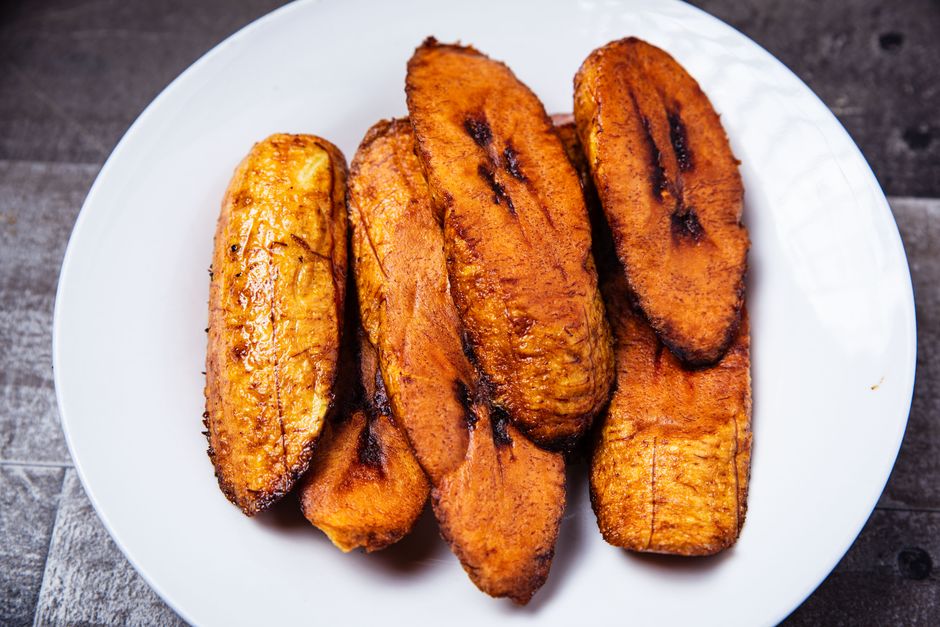
Tatale is a plantain pancake and the two instructions that make it work are both about texture. Mash the plantains with a masher, ricer or mortar and pestle rather than a blender or food processor, because it should not be completely smooth. And once the pancake is firm enough to turn without breaking, press the turner down firmly to flatten it and keep doing that every few minutes. Three or four large over-ripe plantains, four ounces of onion finely grated, two ounces each of rice and wheat flour, two teaspoons of cayenne, three of ginger and a cup of water.
Ingredients
Equipment: Potato masher, ricer, or mortar and pestle — NOT a blender, Griddle or heavy frying pan, Pancake turner, Mixing bowl
- 3 or 4 large over-ripe plantains — about 1 1/2 lb after peeling, or about 3 cups sliced
- 4 oz onion (about 2 medium), or shallots, finely grated
- 2 oz rice flour (about 1/3-1/2 cup)
- 2 oz wheat flour (about 1/2 cup)
- 2 tsp dried ground red cayenne pepper, more or less to taste
- 3 tsp fresh grated or ground ginger
- 1 cup water
- 1/4-1/2 tsp salt (optional)
- About 1 cup oil, for pan frying — palm oil is traditional
Method
- Slice the plantains a quarter to half an inch thick.
- Mash using a potato masher, ricer, or mortar and pestle. It should not be completely smooth.
- Stir in the ginger, cayenne, grated onion, both flours and the cup of water.
- Let the mixture sit 20 to 30 minutes before you cook the pancakes.
- Heat the griddle to medium-high.
- Spoon on the batter.
- As soon as the tatale is firm enough to turn without breaking, carefully turn it with a pancake turner.
- Press the turner down firmly on the pancake to flatten it, and continue doing this every few minutes.
- Serve warm.
Chef Tips
- Mash by hand, never blend. Her instruction is explicit — avoid a blender or food processor — and the reason is in the next line: it should not be completely smooth.
- Press it flat with the turner every few minutes after the first flip. That repeated pressing is what gives tatale its dense, slightly chewy texture instead of a fluffy pancake.
- Twenty to thirty minutes' rest before cooking. The flours need to hydrate and the batter settles.
- Over-ripe plantains, about a pound and a half peeled. Black-skinned is what you want.
- Rice flour AND wheat flour, two ounces each. The rice flour is what keeps it from being bready.
- Palm oil is traditional if you can get it. She notes using a nonstick electric griddle to avoid needing much oil at all.
- The batter can be made a day ahead and refrigerated — her own note, and useful for a breakfast.
Common Mistakes to Avoid
- Using a blender, which gives a smooth batter and the wrong texture.
- Skipping the rest.
- Turning it before it is firm enough, so it breaks.
- Not pressing it flat after turning.
- Merely ripe rather than over-ripe plantain.
Nutrition (per serving)
Health Benefits
- Over-ripe plantain is high in potassium, vitamin A and vitamin B6.
- Rice flour makes it lighter and partly reduces the gluten content.
- Ginger and cayenne both carry documented bioactive compounds.
- Vegan as written.
Cultural Note
Tatale is breakfast or a snack, sold alongside bean stew from the same stall, and the pressing-flat technique is exactly the sort of thing that separates a tatale from a plantain pancake. Its older recorded form was a fermented rice batter, which means the dish has changed substantially in sixty years and the flour version is the one that survived.
Storage & Serving
Storage: 2 days refrigerated. The batter keeps a day raw.
Reheating: A dry pan or griddle. They crisp up again.
Adapted From
- Adapted from 'Recipe #17: Tatale (ripe plantain pancakes)', betumi.com, October 2009 by the URL date. BYLINE FLAG: no byline appeared in the fetched text for this page; the site is Fran Osseo-Asare's and carries the site-level line 'Content/Images © Fran Osseo-Asare'. Ingredients TWO-PASS; the method matched across a second and third fetch.
- Ingredients exactly as printed: '3 or 4 large over-ripe plantains, about 1 1/2 lbs. after peeling), or about 3 cups when sliced' — the unbalanced parenthesis is as printed; 4 oz. of onion (about 2 medium), or shallots, finely grated; 2 oz rice flour (about 1/3-1/2 cup); 2 oz wheat flour (about 1/2 cup); 2 t dried ground red cayenne pepper (more or less to taste); 3 t fresh grated or ground ginger; about a cup of oil for pan frying (palm oil is traditional if you can get it. I usually make these on a nonstick electric griddle so I don't need too much); 1/4-1/2 t salt (optional); a cup of water.
- Method as printed: slice the plantains 1/4-1/2 inch; 'mash using a potato masher, ricer, or mortar and pestle' — one fetch adds: avoid a blender or food processor; 'It should not be completely smooth'; stir in ginger, pepper, onion, flours and 1 cup water; 'let the mixture sit for 20 - 30 minutes before you cook the pancakes', and it can be 'made a day ahead and refrigerated'; heat the griddle at 'medium high heat'.
- THE TURNING AND PRESSING INSTRUCTION, verbatim and the technique that defines the dish: 'As soon as the tatale is firm enough to turn without breaking, carefully turn it over with a pancake turner and press the turner down firmly on the pancake to flatten it. Continue doing this every few minutes.'
- THE TEXTURE RULE, verbatim: 'It should not be completely smooth.' Together with the no-blender instruction, that is the whole reason to mash by hand.
- NO YIELD is printed. The six servings above is an editorial reading of three to four plantains.
- A HISTORICAL DISAGREEMENT, and the reason an older version is NOT published: Whitby 1968, a CSIR Food Research Institute bulletin, describes tatale as made from RICE SOAKED OVERNIGHT AND GROUND, then 'left to ferment for two hours or longer'. That is a fermented rice batter, a quite different preparation from this flour-based one — and it was REFUSED under this collection's fermentation rule, because 'two hours or longer' with no observable cue is not a documented endpoint. So the 1968 record describes a tatale that cannot be published here, and this modern flour-based version is a declared adaptation of a dish whose older form is a ferment. That gap is stated rather than hidden.
- NO FERMENTATION in the published version: the 20-to-30-minute rest is a hydration rest, not a ferment, and the source does not describe it as one.