 Ghanaian · Swallows & Staples
🍚 Yakayake
Yakayake — amo yakayake
Coarse cassava dough with corn flour, steamed about fifteen minutes over a perforated lid — and readiness is indicated by the vapour escaping.
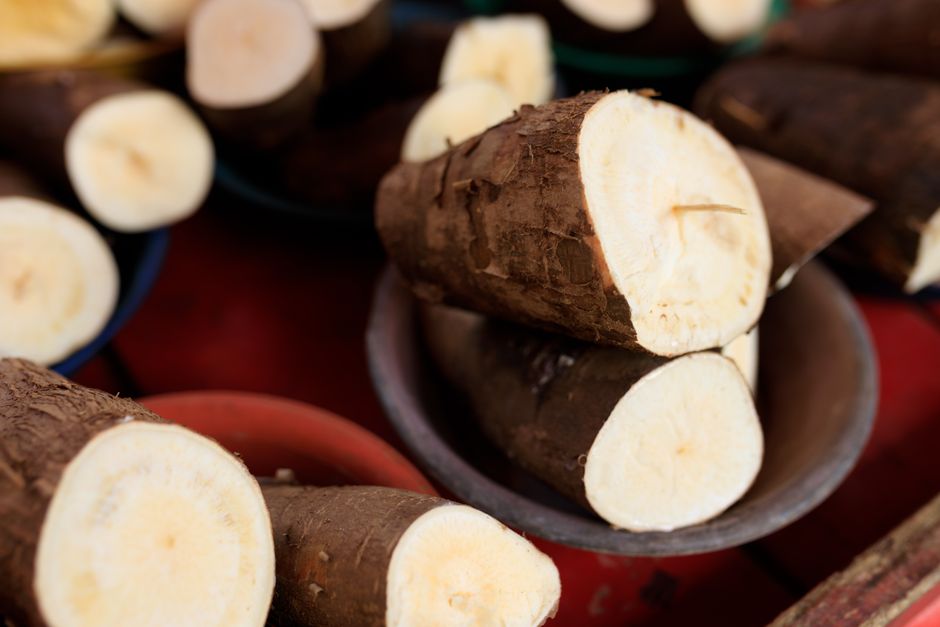
Yakayake is a Volta Region staple and the dough is the thing to get right: coarser than banku dough but the same as gari dough. Cassava is peeled, milled, drained in a basket and then packed into a sack to drain further under a rock. Corn flour and salt are mixed in thoroughly. A quantity of the mixture is poured onto a pot of water covered with a perforated lid and a fine lace, and steamed over boiling water about fifteen minutes. Readiness is indicated by the vapour escaping. The process repeats until the desired amount is cooked.
Ingredients
Equipment: Mill or grater, Draining basket, Sack and a heavy rock, Pot with a perforated lid, Fine lace or muslin
- Cassava, peeled and milled
- Corn flour
- Salt
No quantities are published. See the note.
Method
- Peel and mill the cassava.
- Drain it in a basket.
- Pack it into a sack and drain further under a rock.
- Add corn flour and salt to the dough and mix thoroughly — the dough should be coarser than banku dough, the same as gari dough.
- Bring a pot of water to the boil and cover it with a perforated lid and a fine lace.
- Pour a quantity of the mixture onto the lace.
- Steam about 15 minutes.
ENDPOINT: readiness is indicated by the vapour escaping.
- Repeat until the desired amount is cooked.
- Serve with fish and chilli pepper, or a green leafy soup, or beans.
Chef Tips
- The vapour escaping is the readiness cue and it is a genuinely clever one — while the dough is raw it blocks the steam, and when it is cooked the vapour comes through.
- Coarser than banku dough, the same as gari dough. That texture comparison is the most useful thing in the source, because you can check it against things you know.
- Drain under a rock after the basket. Two stages of draining, and the dough will not hold together if you skip the second.
- A perforated lid with fine lace over it is the traditional steamer. Any steamer insert lined with muslin will do the same job.
- Fifteen minutes per batch, repeated. This is cooked in portions rather than all at once.
- Corn flour is mixed into the cassava dough, so yakayake is not pure cassava. The proportion is not published.
- Eaten with fish and chilli, or with amadetsi or amatadi — green leafy soup or stew — or with beans.
Common Mistakes to Avoid
- Milling the cassava too fine, giving banku dough rather than gari dough.
- Only one draining stage.
- Steaming without a cloth, so the dough falls through.
- Cooking it all in one layer rather than in batches.
- Ignoring the vapour cue and going by the clock alone.
Nutrition (per serving)
Health Benefits
- Gluten-free and fat-free.
- Cassava supplies resistant starch.
- The double draining removes some water-soluble cyanogenic compounds.
- Steamed rather than fried.
Cultural Note
A staple whose doneness is read from the steam coming through it is a nice piece of practical engineering, and the name — dished by a senseless person, after a vendor's own joke — is among the better food etymologies on record. That the Ewe name for it also attaches to the Ga Homowo dish kpokpoi suggests a shared origin nobody has traced.
Storage & Serving
Storage: Same day. It dries out.
Reheating: Re-steam.
Serve with: Fish and chilli pepper, Ademe Detsi, Beans
Adapted From
- PUBLISHED AS A DOCUMENTED PROCESS. NO QUANTITIES EXIST in the source — the corn-flour-to-cassava proportion in particular is not published, and none has been invented. The ingredient list says so.
- SOURCE: Jacqueline Emefa Ampo, Ghana Broadcasting Corporation online, 'Yakayake: A Volta Region Staple, Celebrating Culture and Sustenance', 31 March 2025. The method is credited to a named vendor, ESTHER AGBOVI, who is credited in the display author field as the source of the method.
- THE METHOD, quoted — confirmed across two fetches except the cue sentence, which was seen once: 'Yakayake uses a specific cassava dough, coarser than banku dough, but the same as gari dough. Cassava is peeled, milled, drained in a basket, and further packed in a sac to be drained under a rock. Corn flour and salt are added to the dough and mixed thoroughly. A quantity of the mixture is poured on a pot of water covered with a perforated lid and a fine lace and steamed over boiling water for about 15 minutes. Readiness is indicated by the vapor escaping. The process is repeated until the desired amount is cooked.'
- THE ENDPOINT, 'Readiness is indicated by the vapor escaping', is SINGLE-PASS — seen on one fetch only — and it is the only cue the dish has. It is flagged as such but published, because it is both specific and physically sensible.
- THE NAME STORY, as printed: a vendor who called 'Yakam3 yeke', meaning 'dished by a senseless person'.
- SERVING, as printed: eaten with fish and chilli pepper, with 'amadetsi' or 'amatadi' (green leafy soup or stew), or with beans.
- THE OLDEST RECORD, Whitby 1968, 'Foods of Ghana': cassava 'sifted and steamed to make a dry flat spongy cake (Yakayake)'. She also records a name equivalence worth preserving: 'Kpokpoi (Ga) Amo yakayake (Ewe): This is eaten especially at the Homowo festival by the Gas.' So the Ewe name attaches to what the Ga call kpokpoi, the Homowo festival dish.
- A RELATED GAP: kpokpoi itself was REFUSED in this collection, with no quantified recipe and no fermentation endpoint found. The Whitby name equivalence above is the only link between the two in the material consulted.
- NO FERMENTATION: the draining is mechanical dewatering, as with the cassava dough at Cassava Dough, and no source describes it as a ferment. For a genuinely fermented cassava granule with full endpoints, see akyeke at Akyeke.
- NO YIELD is printed. The six servings above is editorial.