 Nigerian · Soups & Stews
👑 Ofe Owerri
Ofe owerri
Ten cocoyam corms, half a cup of palm oil and as many meats and fish as you can muster — then straight into a cool container at the end to keep the vegetables green.
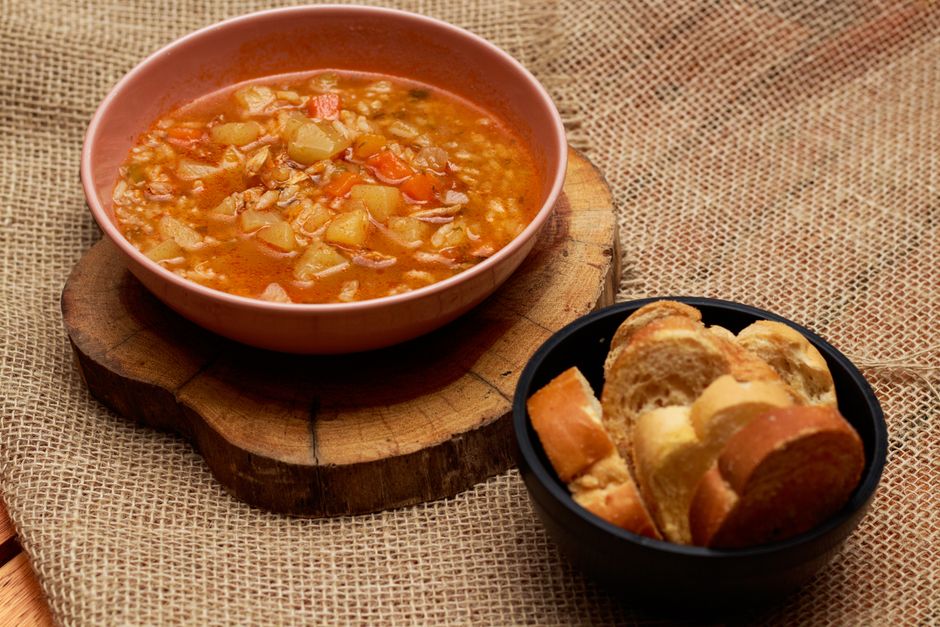
Ofe owerri is the Imo State soup that signals you can afford it: the defining feature is that several types of meat and fish go in, which is traditionally what made it expensive. Ten medium cocoyam corms thicken it and only just enough paste is used to reach a medium thickness. Ugu and okazi go in at the end. The one really distinctive instruction has nothing to do with cooking at all — transfer the finished soup to a cool container immediately, so the vegetables stay green rather than dulling in the residual heat of the pot.
Ingredients
Equipment: Large pot, Separate pot for the cocoyam, Mortar and pestle or blender, A cool container for serving
- Assorted fish — dry fish, stockfish
- Assorted meat — beef, snails, cow skin (ponmo)
- 10 medium cocoyam corms
- 1/2 cup palm oil
- 1/4 cup ground crayfish
- Habanero, to taste
- 4 small seasoning cubes
- 1 medium bunch ugu
- 1 small bunch okazi (afang leaves)
Method
- Soak and clean the dry fish and stockfish.
- Boil the cocoyam corms until soft, then peel and pound or blend to a smooth paste.
- Cook the assorted meat and fish with the seasoning cubes until tender.
- Add the palm oil and the ground crayfish.
- Add the habanero to taste.
- Add just enough of the cocoyam paste to achieve a medium thickness — not all of it if you do not need it.
- Add the okazi, which is tougher, then the ugu.
- Transfer the soup to a cool container immediately, to keep the vegetables green.
Chef Tips
- Transfer it out of the pot the moment it is done. A hot pot keeps cooking and the greens go from bright to drab in minutes.
- Just enough cocoyam paste for a medium thickness. The recipe deliberately does not commit you to using all ten corms' worth.
- Okazi before ugu. Okazi is a tough, slightly bitter leaf and ugu wilts in seconds.
- The point of the dish is the variety of proteins. Beef, snails, ponmo, dry fish and stockfish is the usual spread, and fewer makes a lesser soup rather than a cheaper one.
- Half a cup of palm oil is a lot and it is correct. Ofe owerri is a rich soup.
- No cooking times appear anywhere on the source page. Judge by tenderness and by the thickness you want.
- Okazi is Gnetum africanum, also called ukazi or afang — and it is a different plant from utazi and from uziza despite the similar names.
Common Mistakes to Avoid
- Leaving the finished soup in the hot pot.
- Adding all the cocoyam paste regardless of consistency.
- Putting ugu in before okazi.
- Using only one or two proteins.
- Cutting the palm oil back, which leaves it thin and flat.
Nutrition (per serving)
Health Benefits
- Exceptionally high in protein from the range of meats and fish.
- Cocoyam is high in potassium and resistant starch.
- Okazi and ugu together give a broad micronutrient range.
- Very low in carbohydrate.
Cultural Note
Ofe owerri is a status soup, and openly so — its reputation rests on how many different proteins are in the pot, which historically meant it was cooked for guests and at Christmas rather than on a weekday. The instruction to decant it immediately to keep the vegetables green is a presentation note, and presentation matters in a soup whose whole purpose is to be seen to be generous.
Storage & Serving
Storage: 4 days refrigerated, 3 months frozen.
Reheating: Low heat, briefly. The greens are already at their limit.
Serve with: Akpu or fufu, Iyan, Eba or garri
Adapted From
- Adapted from 'Ofe Owerri', All Nigerian Recipes — no byline on the page, credited to the site. Quantities as printed: assorted fish (dry fish, stockfish) — no quantities; assorted meat (beef, snails, cow skin/ponmo) — no quantities; 10 medium cocoyam corms; 1/2 cup palm oil; 1/4 cup ground crayfish; habanero to taste; 4 small seasoning cubes; 1 medium bunch ugu; 1 small bunch okazi (afang leaves).
- Its headnote places the soup in Imo State and associates it with an Igbo cultural reference to wealth and status, noting that it is distinctive because 'several types of meat and fish are used when preparing Ofe Owerri', which made it traditionally expensive — with a note that one needn't overspend.
- THE THICKENER IS DELIBERATELY IMPRECISE on the page: cocoyam paste, 'just enough…to achieve a medium thickness', with no exact measure. Recorded as printed.
- NO COOKING DURATIONS ARE STATED ANYWHERE on the page. That is a real gap for a soup this elaborate and it is flagged rather than filled with estimates.
- The final instruction is as printed: transfer the soup to a cool container immediately to keep the vegetables green.
- ON OKAZI, from Tayo Oredola, Low Carb Africa: afang or okazi is Gnetum africanum, 'Afang leaves (Ibibio), Okazi/Ukazi (Igbo)', common in the southeast — 'It has a slightly bitter taste when used in dishes. These leaves are mixed with water leaf to prepare Afang soup and Okazi soup.'
- ON UGU, same source: 'Ugwu/Ugu (Igbo), Ewe Elegede (Yoruba), Ikong-Ubong (Efik/Ibibio), Kabewa (Hausa)' — fluted pumpkin leaves, 'an excellent source of dietary fiber' containing 'many vitamins, minerals, and antioxidants'. The Efik name ikong ubong is the one used in edikang ikong (Edikang Ikong, Edikang Ikong with Six Bunches of Ugwu).