 Senegalese · Soups & Stews
🐟 Domoda with Fried Fish
Domoda au poisson, sauce béchamel sénégalaise
Fried fish steeped two minutes in a tomato sauce thickened with flour — a ‘domoda’ without a single peanut, from the Slow Food/FAO Senegal booklet.
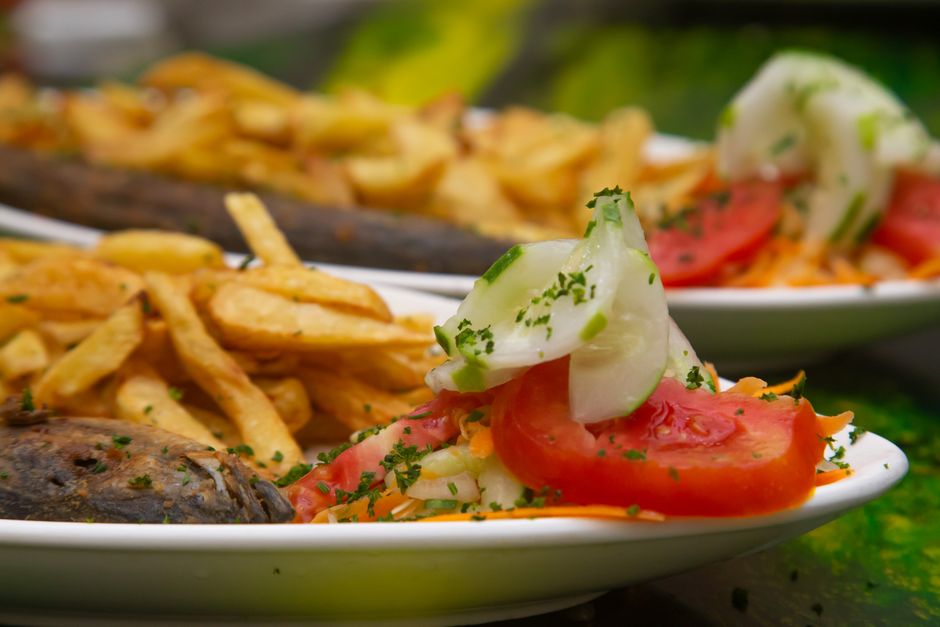
Under this name the Slow Food and FAO booklet prints a fish dish, not a groundnut stew. Ten medium fish are fried, and a sauce is built from a quarter litre of oil, a hundred grams of tomato concentrate and 150 grams of cherry tomatoes crushed together and cooked a minute, with onion, garlic, a spoonful of vinegar or lemon, dried fish and fermented yet. A litre of water goes in, vegetables cook in it, 30 g of flour loosened in half a glass of water thickens it, and the fried fish soak in the finished sauce for two minutes. It is served on white rice, which the booklet calls niangkatang.
Ingredients
Equipment: Large pot, Frying pan for the fish
- 10 medium fish
- 250 ml oil
- 150 g cherry tomatoes
- 100 g tomato concentrate
- 1 onion
- 3 garlic cloves
- 1 spoonful of vinegar or lemon juice, to taste
- 1 litre water
- Vegetables of your choice — quantity not printed
- 30 g wheat flour, diluted in half a glass of water
- 25 g dried fish
- 25 g yet (fermented dried sea snail, bought)
- Salt, pepper and chile (optional) — quantities not printed
- White rice, to serve
Method
- Fry the fish in oil. The source gives no frying time or temperature.
- Cook the tomato concentrate and the crushed cherry tomatoes in the oil for about one minute. Add the onion, garlic, vinegar or lemon, the dried fish and the yet.
- Add 1 litre of water and the vegetables. Cook until the vegetables are done.
- Dilute the flour in half a glass of water and stir it in to thicken the sauce.
- When the vegetables are cooked, put the fried fish in the sauce to steep for 2 minutes.
- Serve on white rice.
Chef Tips
- The one printed cue is the order: vegetables cooked first, then the fish, then only two minutes in the sauce — so the fried skin does not go soft.
- Dilute the flour in cold water before adding; stirred in dry, it clots.
- Dried fish and yet are bought ingredients here; the booklet gives no fermentation step for them.
Common Mistakes to Avoid
- Leaving the fish in the sauce longer than two minutes.
- Adding the flour dry.
- Treating this as the Gambian peanut domoda — the source’s version has no peanut.
Nutrition (per serving)
Health Benefits
- Fish supplies protein and omega-3 fats.
- Tomato concentrate gives lycopene.
- Dairy-free.
Cultural Note
‘Domoda’ is best known as the Gambian groundnut stew, and in the English-language press that is almost always what the word means. The Slow Food booklet uses it for a fish in a flour-thickened tomato sauce — which it calls ‘béchamel sénégalaise’ — and the two meanings are recorded here side by side.
Storage & Serving
Storage: 2 days refrigerated; the fried fish softens in the sauce.
Reheating: Gentle heat, covered.
Serve with: White rice
Adapted From
- Source: ‘produits et plats traditionnels / Sénégal / de la terre à la table’, Slow Food Foundation for Biodiversity with FAO (project GTF/RAF/426/ITA), Italian cooperation. Direction: Velia Lucidi and Serena Milano; texts by Serena Berisio; recipes credited to chef Bineta Diallo Dioh. No publication date printed. Yield as printed: ‘Pour 10 personnes’. TWO-PASS at two independent URLs (fao.org and fondazioneslowfood.com), line-level agreement on every quantity.
- Doneness cue, short fragment: ‘Quand les légumes sont cuits’, then the fried fish steep ‘2 minutes’. No temperature anywhere.
- ABSENT, not estimated: the vegetables (‘légumes de votre choix’), the salt, pepper and chile, and any frying time. The fish species is not named. The flour is stated to be diluted in ‘un demi-verre d’eau’.
- UNRECONCILED NAMING: this source prints a peanut-free dish under the name ‘domoda’; elsewhere in the world the name usually means a Gambian peanut stew. No source in this collection resolves which is the Senegalese usage.