 Somali · Bread
🍞 Muufo Baraawe
Muufo Baraawe — Maanda
The bread of Brava, called maanda in the Bravanese language — a wet semolina dough shaped by hand and pressed around the inside of a screaming-hot wok, baked covered until the loaves pull away from each other.
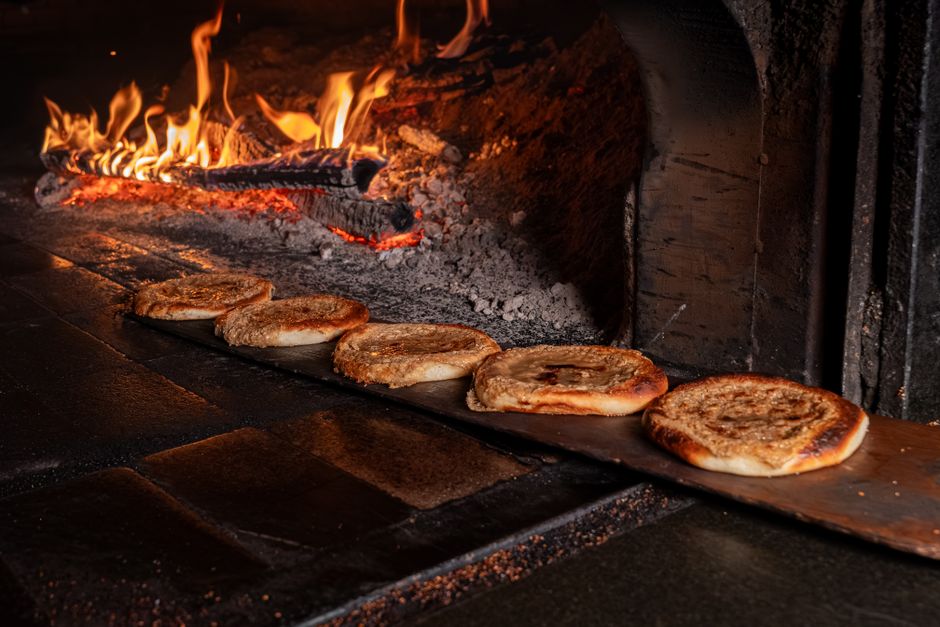
In Brava this bread is baked twice a day, every day of the year: in the morning for breakfast and again in the late afternoon for dinner. Traditionally it took two days and two trips to the mill — white dehydrated maize crushed in a woven basket, skinned, soaked overnight, then ground again into a paste the Bravanese call kuta, mixed with a starter saved from yesterday's baking and raised while the clay oven heated. This version uses semolina and instant yeast and takes an afternoon, which is why it is the version that survives in kitchens outside Somalia.
Ingredients
Equipment: Large wok with a lid, or a deep ovenproof pan with a lid, Large mixing bowl, Bowl of water, for wetting the hands
Two grades of semolina — the texture depends on using both
- 3 cups fine semolina
- 3 cups coarse semolina
The rest
- 100 g (1/2 cup) sugar
- 1 tbsp instant dry yeast
- 1/2 tsp baking powder
- 1/2 tsp salt
- 950 ml (4 cups) water
- Oil, for the wok
- A little flour, for dusting the wok
Method
- Combine both semolinas, the sugar, yeast, baking powder and salt in a large bowl and mix.
- Add two thirds of the water and mix, then add the rest and mix thoroughly until there is not a lump left. The dough is very wet — closer to a thick batter than a bread dough.
- Cover and leave somewhere warm for 2 hours. It will roughly double and turn visibly elastic.
- Heat the oven to 232C / 450F. Oil the wok, dust it with a little flour and wipe the excess away.
- Get the wok properly hot — this is what sets the crust.
- Wet your hands, take a fistful of dough and shape it into an oblong, then press it against the side of the wok about halfway up.
- Repeat around the wok until the sides are covered and no gap remains.
- Cover the wok with its lid and put it in the oven. Bake for 30 minutes.
- Take it out and let it cool. Once cool enough to touch, the loaves separate from one another easily.
Chef Tips
- No plain flour is needed anywhere in this dough. With both grades of semolina the bread comes out light and open.
- If you can only get coarse semolina, add 1/2 cup of plain flour for every cup of semolina. Cream of Wheat works with no flour added at all.
- Cornmeal can stand in for the semolina, but it has to be soaked in boiling water overnight first, then mixed with the yeast, flour and sugar and left to rise.
- No oven and no wok: loosen a little of the risen dough with water and cook it on a lightly oiled griddle. Add more sugar to the dough and you have the sweet version.
- Traditional Brava maanda was not oven-baked at all — a fire was lit below the pot and coals laid on the lid so the heat came from every side. A covered wok in a hot oven is doing the same thing.
Common Mistakes to Avoid
- Adding plain flour because the dough looks too wet. It is supposed to look too wet, and flour makes it dense.
- Not waiting out the full 2-hour rise, which gives flat, heavy loaves with no open crumb.
- Pressing the dough into a cold or barely warm wok, so it slides down the sides instead of gripping.
- Using hot water to mix — it kills the yeast. Lukewarm is right; cold merely slows the rise.
- Baking uncovered. Without the lid the steam escapes and the crust sets before the loaves have risen.
Nutrition (per serving)
Health Benefits
- Semolina is a durum wheat product, higher in protein than plain white flour.
- No fat in the dough itself beyond what oils the pan.
Cultural Note
Baking maanda was a household operation that pulled in the children: Qur'anic-school-age children carried the maize to the mill in a woven basket called a shkapu and carried the crushed grain home again. The starter dough, khamiiri, was kept back from each day's batch to raise the next — so a family's bread was in a real sense continuous.
Storage & Serving
Storage: Wrapped, at room temperature, up to 2 days. Freezes well for a month.
Reheating: Warm briefly in a dry pan or a hot oven to bring the crust back.
Serve with: Malaay la Shiilay, Taraaqad, Shaah Cadays