 Ugandan · Street Food & Snacks
🥨 Bagiya
Bagiya
Two parts gram flour to one part wheat, seasoned with garam masala and onion-garlic paste, loosened to a thick paste and piped straight into hot oil.
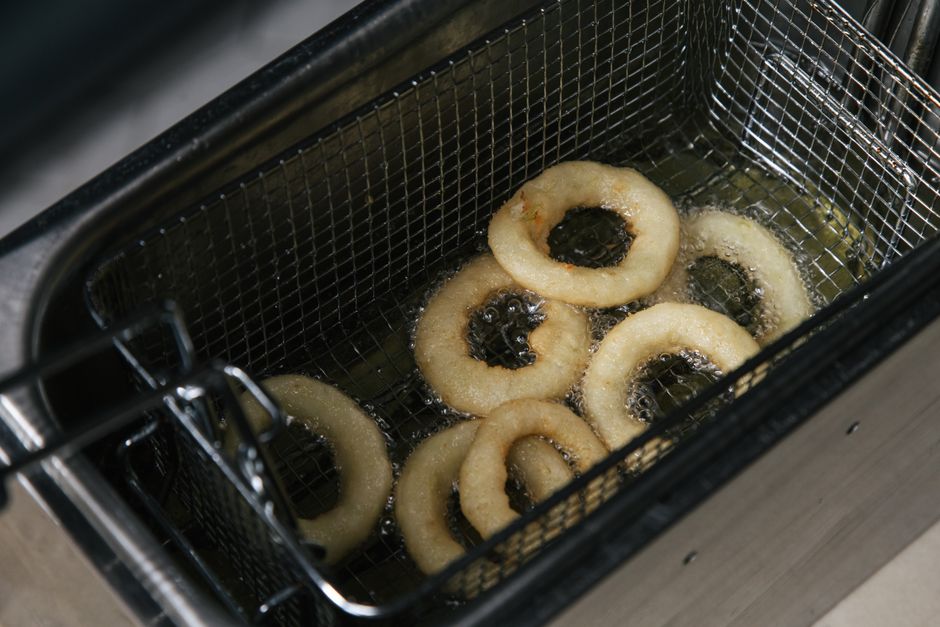
Bagiya is an Indian-inspired Ugandan snack made from gram and wheat flours, sold on the street and eaten cool with roasted groundnuts and hot chai. It is also the clearest example in Ugandan food writing of a dish that nearly slipped away: the cook who published this recipe tried to make them at home, realised she did not know how, asked around and found that almost nobody did. This recipe is her reconstruction after many failures, and it is the best one there is. The two-to-one flour ratio scales to any batch size.
Ingredients
Equipment: Bowl, Heavy-duty piping bag, or a potato masher, Deep frying pot, Slotted spoon
- 240 ml (1 cup) gram flour (besan)
- 120 ml (1/2 cup) white wheat flour
- 240 to 480 ml (1 to 2 cups) water
- 15 ml (1 tbsp) garam masala or curry powder
- 15 ml (1 tbsp) onion and garlic paste
- 2.5 ml (1/2 tsp) black pepper
- 2.5 ml (1/2 tsp) salt
- Oil, for deep frying
To serve
- Roasted groundnuts
Method
- Put all the dry ingredients in a bowl and mix well.
- Add the onion and garlic paste and mix well.
- Add the water gradually while mixing, until you have a paste-like texture.
- Put a frying pot with enough oil to deep-fry over medium-high heat and let the oil heat up.
- Spoon the bagiya paste into a piping bag and cut a hole at the bottom, sized for the bagiya you want.
- Pipe the paste directly into the hot oil.
- Fry until golden brown.
- Lift out and drain.
- Serve cool with roasted groundnuts and a cup of hot chai masala.
Chef Tips
- Two parts gram flour to one part wheat. That ratio is the recipe and it scales to any batch you like.
- Wheat flour was chosen by experiment over cassava and rice — it holds flavour well and gives the right crunch. The other two were tried and rejected.
- Add the water gradually. You are aiming at a thick paste that will hold its shape coming out of a piping bag, not a batter.
- Medium to medium-high oil. Too hot and the outside sets before the inside cooks.
- A heavy-duty piping bag handles this better than a light one. A potato masher pushed through gives you smaller bagiya, which some people prefer.
- Serve cool, not hot. They crisp as they cool and that is how they are eaten on the street.
- Roasted groundnuts and hot chai alongside is the traditional pairing and it is worth doing properly.
- This recipe is a reconstruction rather than an inheritance — the cook who wrote it could not find anyone who knew the method, and arrived at it by trial after many failures. It is honest work, not received wisdom.
Common Mistakes to Avoid
- Making it too thin, so it disperses in the oil instead of holding a shape.
- Changing the flour ratio.
- Oil too hot.
- Serving them hot.
- Using a flimsy piping bag that bursts under the paste.
Nutrition (per serving)
Health Benefits
- Gram flour is high in plant protein, fibre and folate, and is naturally gluten-free on its own.
- Garam masala, onion and garlic all go in raw to the paste.
- No dairy and no egg.
- Deep-fried, so it is a snack rather than a staple.
Cultural Note
Bagiya sits exactly at the join between Uganda's Indian inheritance and its street food, and its near-disappearance as a home recipe is a real loss that one cook partly reversed. That the most searched thing on a Ugandan food blog was a snack nobody could explain how to make says something about how oral this cuisine still is.
Storage & Serving
Storage: 3 days in an airtight container once fully cool.
Reheating: A hot oven for a few minutes to re-crisp.
Serve with: Roasted groundnuts, Chai masala, Mandazi
Adapted From
- Adapted from Sophia Musoki, 'Let's Make Bagiya', A Kitchen In Uganda (5 August 2021) — all quantities, the 2:1 flour ratio, the piping-bag method, the medium-to-medium-high oil and the serve-cool-with-groundnuts-and-chai instruction are hers.
- The reconstruction is flagged because she flags it herself: in 2019 she wrote that she attempted bagiya at home only to realise she did not know how they were made, took to Instagram and was surprised to find almost no one else knew either; in 2021 she wrote that bagiya was the most searched keyword on her blog and that she experimented through many failures until she had a recipe.
- Her finding that wheat flour retains flavour and gives a perfect crunch, tested against cassava and rice flours, is from the same post, as is her description of bagiya as an Indian-inspired Ugandan snack.