 Ugandan · Vegetables & Legumes
🍢 Steamed Bitter Yams
Kobe — lisankonyo; Balugu — ndaggu
Five kilos of air yam bulbils soaked and then steamed in banana leaves for up to two hours — the soaking and the long cook are what detoxify them, not a preference.
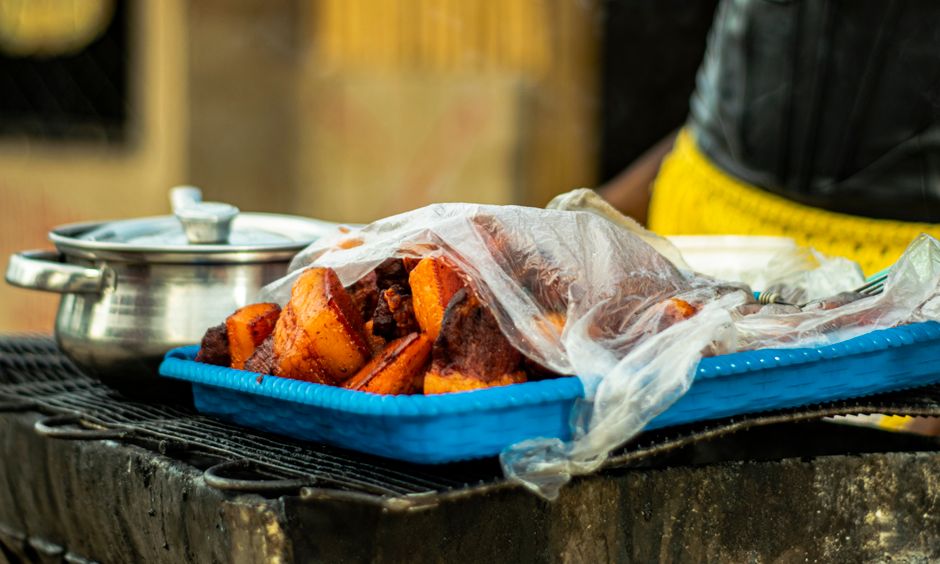
Kobe are the dark brown bulbils that grow at the base of the air yam's leaves, and they need soaking and then boiling or steaming before they can be eaten at all. That is not a texture choice. Balugu, the climbing yam, is the same family and the same rule applies with more force — its tubers can reach eighty kilos and require thorough boiling or sun-drying to remove their toxic constituents. In Mbale, elders give kobe to boys who have just been circumcised, to speed the healing.
Ingredients
Equipment: Large bowl, for soaking, Deep pan with a tight lid, Banana leaf spines, for the steaming rig
- 5 kg air yams (kobe), or climbing yam (balugu) cut into pieces
- 2 banana leaves
- Water, for soaking and steaming
To serve
- Salt, or groundnut paste
Method
- Soak the bulbils in water. This is part of the detoxification and is not optional.
Steaming
- Wrap the soaked yams in the banana leaves.
- Set them on a bed of banana leaf spines in a deep pan, with water below the spines so it never touches the parcel — the rig described in Ebwanga.
- Cover the pan tightly.
- Steam for up to 2 hours, until completely tender.
- Serve with salt, or in a groundnut sauce.
Chef Tips
- Soak, then boil or steam. Air yam bulbils must be detoxified this way before eating, and undercooked yam of this family is genuinely unpleasant and not safe. Two hours is the cook time and it is not padding.
- Climbing yam — balugu — needs thorough boiling or sun-drying for the same reason, and its tubers grow far bigger, which means longer.
- The banana leaf and spine rig is the same one used for matooke, luwombo and ebwanga. Water below the spines, food above, lid on.
- Uncooked bulbils keep more than six months, which is why they matter as a food. Cooked, they last about two weeks.
- Balugu varieties worth knowing: kyetutumula is the most common, then luyiki, nandigoya, mukulu jjuuni, kisebe and kikongo. Ndaggu is a separate species cultivated around Bukunja in Buikwe district.
- Five kilos is a family or ceremonial quantity. The ratio of leaves to yam scales roughly.
- In Mbale these are given to boys after imbalu circumcision to accelerate healing — one of the clearest cases of a Ugandan food with a specific medicinal role.
- Uganda has numerous species and ecotypes of climbing yam under more than ten local names, so what you are sold under one name may be a different plant.
Common Mistakes to Avoid
- Skipping the soak.
- Cutting the steaming short.
- Letting the water touch the parcels.
- Treating balugu like a potato — the size alone means it needs far longer.
- Buying cooked bulbils and keeping them as long as raw ones.
Nutrition (per serving)
Health Benefits
- High in complex carbohydrate, fibre and potassium.
- Contains diosgenin and related compounds, which is also why they must be cooked properly.
- Steamed with nothing added.
- Exceptional natural storage life, which is why they matter in a food system without refrigeration.
Cultural Note
Yams like these are food-security crops — they keep half a year uncooked in a climate with no cold chain, and they grow with almost no attention. That one of them doubles as a healing food after circumcision is the kind of dual role that gets lost when a cuisine is catalogued as a list of dishes.
Storage & Serving
Storage: Cooked, up to 2 weeks. Uncooked bulbils keep over 6 months.
Reheating: Steam again for a few minutes.
Serve with: Binyebwa, Ttimpa in Groundnut Soup, Salt alone
Adapted From
- Adapted from 'Steamed Bitter Yams or Air Yams', p14 of 'Traditional Products and Dishes: Uganda — From Earth to Table', second edition 2018, Slow Food International — the 5 kg of yams, the 2 banana leaves and the steam-for-up-to-2-hours instruction are as printed there.
- The kobe entry, p13, gives the detoxification requirement — the bulbils must be soaked and then boiled or steamed — the storage figures of more than six months uncooked and up to two weeks cooked, and the Mbale imbalu healing use, where elders say the plant is medicinal and it was always given to boys who had just been circumcised to accelerate healing.
- The balugu material — growth to 6 to 8 metres, tubers in bunches up to 80 kilograms, the requirement for thorough boiling or sun-drying to remove toxic constituents, the named varieties kyetutumula, luyiki, nandigoya, mukulu jjuuni, kisebe and kikongo, and ndaggu as a separate Bukunja-Buikwe species — is from p13 of the same booklet.
- The banana leaf and spine steaming rig is not in that source and is taken from Ebwanga, which is the only written record of it.