 Ghanaian · Main Dishes
🟤 Aboboi
Aboboi — aboboe, bambara bean stew, azinogoe bobɔ
Bambara beans simmered uncovered one to two hours until tender, with Romano peppers and chillies roasted twenty-five minutes at a hundred and eighty.
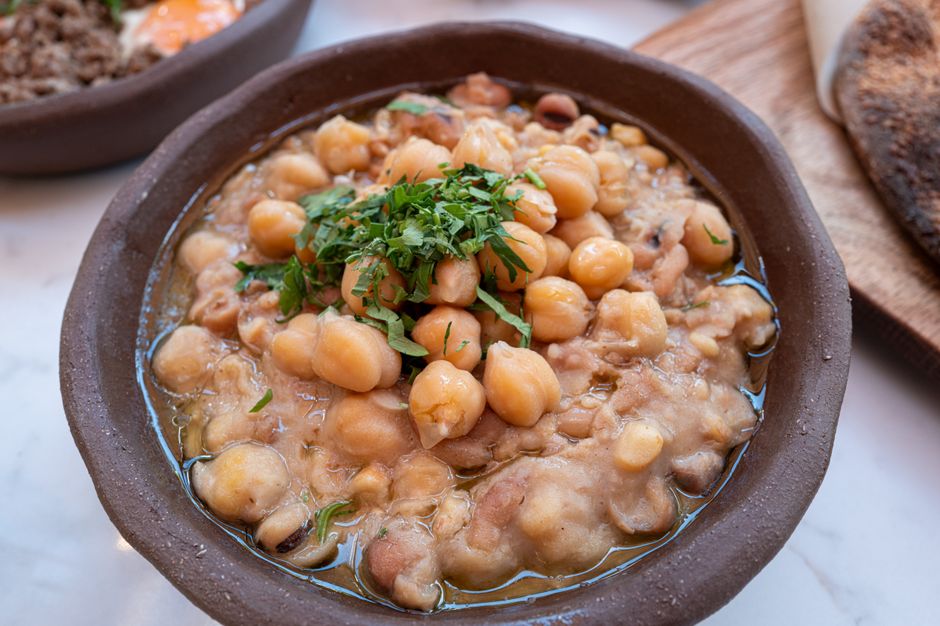
Bambara groundnuts are a West African legume that grow underground like peanuts but cook like beans, and aboboi is the stew made from them — usually eaten with tatale. This version is a declared adaptation: three hundred grams of dried bambara beans boiled two to three minutes with the froth skimmed, then simmered uncovered one to two hours until tender, while two hundred grams of Romano peppers and three or four red rocket chillies roast at a hundred and eighty degrees for twenty-five minutes. The credited cook is Fante, so it is neither the Ewe nor the northern version.
Ingredients
Equipment: Large pot, Roasting tray, Blender, Skimming spoon
- 300 g dried bambara beans, or dried chickpeas
- 750 ml water
- 1 1/2 red onions, finely chopped
- 1/2 tsp sea salt
- 200 g Romano peppers
- 3-4 red rocket chillies
- 10 g thyme leaves
- Olive oil
- 7.5 cm fresh root ginger
- 2 garlic cloves
- 1/2 tbsp ground hot pepper
- 1 tbsp sugar
- 3 tbsp dried ground prawn or shrimp powder (optional)
Method
- Soak the bambara beans — about 24 hours is the documented traditional soak.
- Cover with the 750 ml of water and boil 2 to 3 minutes, skimming the froth.
- Simmer uncovered 1 to 2 hours, until tender.
- Meanwhile heat the oven to 180 degrees.
- Roast the Romano peppers and rocket chillies 25 minutes.
- Blend the roasted peppers with the ginger, garlic, ground hot pepper and thyme.
- Soften the onions in olive oil.
- Add the blended pepper mixture, the sugar, the salt and the optional prawn powder.
- Stir in the cooked beans and simmer to bring together.
- Serve with tatale.
Chef Tips
- Skim the froth during the first two to three minutes of boiling. Bambara beans throw a lot of it and it carries the compounds that cause wind.
- Simmer UNCOVERED for the one to two hours. Covered, bambara beans foam over.
- Her own headnote warns that cooking time varies enormously — one batch can take two hours and another three to four. Note that this contradicts the recipe's own one-to-two-hour figure, and it is the headnote that is probably honest.
- Roasting the peppers is this version's departure from tradition, and it does give a sweeter, deeper base than frying them would.
- A tablespoon of sugar balances the bambara bean's earthiness. The 1968 government survey records that sugar is often added in cooking aboboe, so this is traditional rather than an invention.
- Bambara beans are harder than most legumes. A twenty-four-hour soak is the documented traditional practice and it is worth the planning.
- Aboboi is classically eaten with tatale, the plantain pancake. The pairing is as fixed as ampesi with kontomire.
Common Mistakes to Avoid
- Not skimming the froth.
- Covering the pot.
- Trusting the one-to-two-hour figure over the headnote's two-to-four.
- Skipping the soak.
- Leaving out the sugar, which the oldest record says is usual.
Nutrition (per serving)
Health Benefits
- Bambara groundnuts are a complete protein, unusually for a legume.
- Very high in soluble fibre, folate and iron.
- Vegan as written without the prawn powder.
- Roasted peppers are very high in vitamin C.
Cultural Note
Bambara groundnuts are one of Africa's genuinely underused crops — drought-tolerant, nitrogen-fixing and nutritionally close to a complete protein — and aboboi with tatale is the dish that keeps them in the kitchen. That the best-credentialed source calls it Ewe while the only retrievable recipe comes from a Fante cook shows how widely it travels.
Storage & Serving
Storage: 4 days refrigerated, 3 months frozen.
Reheating: Gentle heat with water to loosen.
Adapted From
- Adapted from 'Aboboi - Bambara Bean Stew' by Zoe Adjonyoh, from Zoe's Ghana Kitchen (Octopus Books), published on souschef.co.uk, 1 September 2020. Quantities confirmed across two fetches (TWO-PASS).
- Ingredients exactly as printed: 300g dried bambara beans (or dried chickpeas); 1½ red onions, finely chopped; ½ teaspoon sea salt; 200g Romano peppers; 3-4 red rocket chillies; 10g thyme leaves; Olive oil; 7.5cm fresh root ginger; 2 garlic cloves; ½ tablespoon ground hot pepper; 1 tablespoon sugar; 3 tablespoons dried ground prawn/shrimp powder (optional). Oven 180°C; water '(750ml)'.
- Method as printed: 'Boil 2-3 minutes, skimming froth, then simmer uncovered 1-2 hours until tender'; roast 25 minutes.
- AN INTERNAL INCONSISTENCY IN THE SOURCE, flagged and NOT corrected: the headnote says 'one batch can take 2 hours and another 3-4 hours' while the method says 1-2 hours. The two do not agree. Both are recorded and the tips advise trusting the headnote's wider range.
- AUTHOR-DECLARED ADAPTATION: this is an OVEN-ROASTED-PEPPER version, which is not traditional. The credited cook is a FANTE cook, 'Aunty Cynthia', so it is NEITHER the Ewe nor the northern version of the dish — which matters because the dish is attributed differently by different sources.
- THE OLDEST RECORD, Whitby 1968, verbatim: 'Round beans. Bambarra ground nuts... Akyi, Atwe (Twi) Akwen (Ga) Azi kpodoe (Ewe) Aboboe (the cooked beans).' And on method: 'The beans are usually soaked twenty-four hours before cooking and are then boiled till soft. The result in the south is a sort of porridge with beans floating in it called aboboe. Red pepper, salt and often sugar are added in cooking... In the north boiled round beans may be eaten with stew-like cowpeas.' THAT is the source for the 24-hour soak and for sugar being usual, and it also documents that the northern and southern treatments differ.
- THE EWE ATTRIBUTION, from Osseo-Asare & Baëta, The Ghana Cookbook (2015), 'Stewed Bambara Beans', 6 to 8 servings, Easy — headnote quoted: 'The Ewe people are found in parts of Togo and Benin and especially in the Volta Region in Ghana. Stewed Bambara Beans is a simple, everyday kind of dish that the Ewe and other Ghanaians enjoy. It is called azinogoe bobɔ in Ewe, a version of "aboboe" in Twi and Ga.' ITS INGREDIENTS AND METHOD ARE NOT VISIBLE behind the publisher's paywall. So the best-credentialed source for this dish attributes it to the Ewe, while the only retrievable recipe comes from a Fante cook via a British cookbook. Both are recorded.
- A NORTHERN ABOBOI RECIPE WITH QUANTITIES: EMPTY. Whitby describes the northern treatment in one clause and nothing else was found.
- PRODUCT-DEVELOPMENT RECIPES, recorded not published: Nti C.A., University of Ghana, 'New Recipes for Enhanced Bambara Utilization in Ghana with Nutrition Information', DFID/CPHP/FRI Bambara project, November 2004. These use 'High Quality Bambara Flour (HQBF)' and are NOT traditional. Bambara Tuo Zaafi: Polished corn flour 50g (½ cup); HQBF 240g (1 cup); Water 600 ml (2 cups); 'Mix HQBF with water, bring to boil and allow to cook for 5-10 minutes while stirring. Add corn flour bit by bit...' Bambara Kokonte: HQBF 120g (½ cup), Cassava flour 200g (2 cups), Water 600 ml (2 cups). SOURCE INCONSISTENCIES, reported not corrected: '600 ml (2 cups)' is not volume-equal, and its kakro recipe lists 'HQBF 60g (½ cup)' against 120g (½ cup) elsewhere. A companion report, 'Standardized existing traditional bambara flour recipes for Northern Ghana' (Nti 2004, R8261a), WAS NOT RETRIEVABLE — which is where the traditional northern quantities would have been.
- OLIVE OIL and ROMANO PEPPERS are this author's substitutions and are flagged as such.