 Ghanaian · Drinks & Beverages
🍺 Pito
Pito — northern grain beer
Sorghum malted five days, soured to pH 4.25, then fermented with the dambile yeast head at ambient twenty-eight to thirty-two degrees.
Pito is the sorghum beer of northern Ghana and it is a two-stage fermentation: a spontaneous lactic souring followed by an alcoholic fermentation using a yeast head saved from the previous brew. Published here as a documented process because no household recipe with quantities exists. The souring endpoint is specific — the typical sour point of the traditional pito process is pH 4.25 with 0.33 per cent lactic acid. The alcoholic stage runs at ambient twenty-eight to thirty-two degrees from an original extract of thirteen degrees Plato to 4.2 per cent alcohol and a final pH of 3.5. It is drunk while still fermenting.
Ingredients
Equipment: Steeping vessel, Jute sacks, for germination, Drying trays, Mill, Large brewing pot, Straining cloth
- Red sorghum grain, for malting
- Water
- Dambile — the yeast head saved from a previous brew
No household quantities are published. See the note.
Method
- Steep the sorghum 12 to 12.5 hours for the optimised process, or overnight traditionally.
- Germinate 5 days at 30 degrees — traditionally 4 to 6 days under a cover of jute sacks, sprinkled with water daily except on the last day.
- Dry at 40 degrees for the optimised process, or sun-dry two or more days traditionally.
- Grind the malt and mix with water.
- Boil 3 to 4 hours.
- Leave to undergo spontaneous lactic acid fermentation at ambient temperature, 28 to 32 degrees — about 12 hours.
SOURING ENDPOINT: pH 4.25 with about 0.33 per cent lactic acid. That is the typical sour point of the traditional process.
- Dilute, then cook about 3 hours.
- Cool.
- Pitch the dambile yeast head from a previous brew and ferment 12 to 24 hours at ambient temperature.
ALCOHOLIC ENDPOINT: from an original extract of about 13 degrees Plato to about 4.2 per cent alcohol and a final pH of about 3.5.
- Drink while still fermenting — the shelf life is 2 to 3 days.
Chef Tips
- The souring endpoint is the number to work to: pH 4.25 with about a third of a per cent lactic acid. That is the one hard figure in the traditional process and it comes from a study that measured real brews.
- Dambile is the yeast head skimmed from the previous brew and carried forward. It is what makes pito a continuous tradition rather than a recipe.
- Five days' germination at thirty degrees is the optimised figure, against four to six days traditionally under jute sacks. Sprinkle water daily except the last day.
- Two separate fermentations, and they do different things — the first sours, the second makes alcohol. Skipping the souring gives you something that is not pito.
- It is drunk while still fermenting and keeps two to three days. There is no finished, stable pito.
- Finished-product pH across studies runs 3.2 to 3.6 or 3.5 to 5, and alcohol 1.4 to 4 per cent. Those are ranges of what is sold, not targets to brew to.
- No published Ghanaian source states how brewers judge completion — one review says so explicitly. The pH figures above are the nearest thing to an endpoint anyone has measured.
Common Mistakes to Avoid
- Skipping the lactic souring stage.
- Pitching a commercial yeast instead of dambile and expecting the same result.
- Treating the finished-product pH ranges as brewing targets.
- Storing it — it does not keep.
- Watering the malt on the last day of germination.
Nutrition (per serving)
Health Benefits
- A significant source of B vitamins from the yeast and lactic bacteria.
- Sorghum is gluten-free.
- Low in alcohol by beer standards at around 2 to 4 per cent.
- The lactic souring makes the grain's minerals more available.
Cultural Note
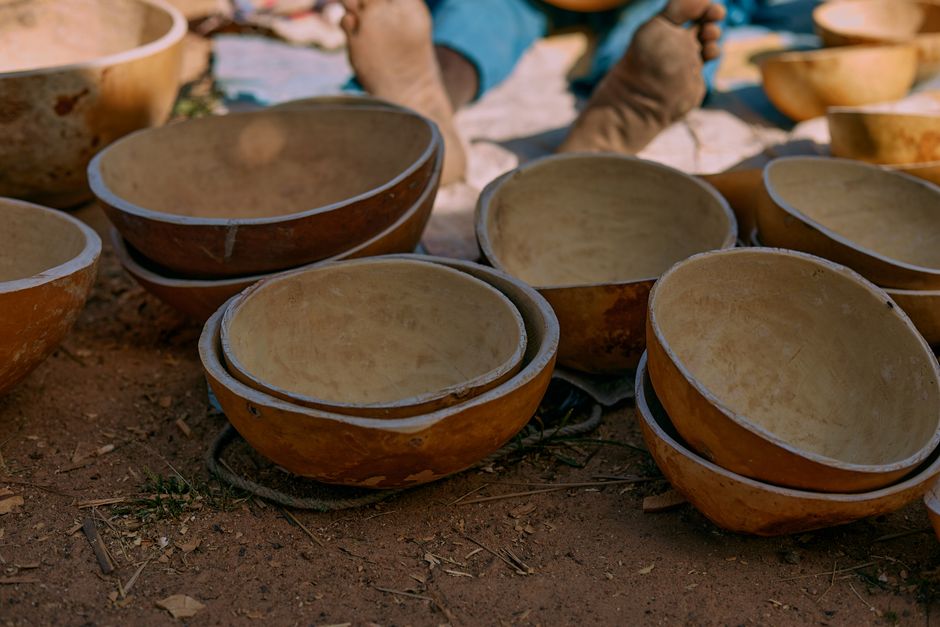
Pito is drunk from calabashes at pito bars across northern Ghana, lukewarm and still working, and the dambile yeast head carried from brew to brew means a given bar's pito has a continuous microbial lineage. That nobody has published how a brewer knows when it is done — while four separate studies have measured its pH — is a good summary of the gap between research and practice.
Storage & Serving
Storage: 2 to 3 days, and it is drunk while still fermenting.
Reheating: Not applicable. Drunk lukewarm.
Serve with: Drunk on its own, lukewarm, Tuo Zaafi, Grilled Guinea Fowl
Adapted From
- PUBLISHED AS A DOCUMENTED PROCESS, NOT A HOUSEHOLD RECIPE. NO RECIPE WITH QUANTITIES was accepted from any source; none have been invented and the ingredient list says so.
- A DISCLOSURE: on the first research pass pito was REFUSED outright, because every Ghanaian source consulted gave times with no observable cue, and one review states plainly that there is 'no explicit statement regarding how brewers judge fermentation completion.' A second, targeted pass found the measured souring endpoint below, which is what makes this entry publishable.
- THE SOURING ENDPOINT, from Djameh C., Ellis W.O., Oduro I., Saalia F.K., Haslbeck K., Komlaga G.A., 2019, 'West African sorghum beer fermented with Lactobacillus delbrueckii and Saccharomyces cerevisiae: fermentation by-products'. SINGLE-PASS. Verbatim: the souring is 'left to undergo spontaneous lactic acid fermentation at ambient temperature (28–32°C)', and the endpoint is 'the typical sour point of the traditional pito process (pH 4.25, 0.33% lactic acid)'. THE SOURING DURATION WAS NOT OBTAINED from that paper. Its alcoholic stage, traditional route: ambient 28-32 °C with the dambile yeast head from a previous brew, original extract 13 °P, alcohol 4.2%, final pH 3.5. Its pure-culture comparison gave 3.6% alcohol and pH 3.6, using L. delbrueckii at 45 °C for 12 h.
- THE PROCESS SEQUENCE, from Sawadogo-Lingani H., Owusu-Kwarteng J., Glover R., Diawara B., Jakobsen M., Jespersen L., 'Sustainable Production of African Traditional Beers With Focus on Dolo...', Frontiers in Sustainable Food Systems, 2021, quoted: 'Grinding, Mixing with water, Boiling (3-4 h), Acidification (12 h), Dilution, Cooking (3 h), Cooling, Alcoholic fermentation (12-24 h) with local starter yeast' — citing Sefa-Dedeh et al. 1999, van der Aa Kühle et al. 2001, Kolawole et al. 2007, Lyumugabe et al. 2012 and Zaukuu et al. 2016.
- FINISHED-PRODUCT RANGES, which are NOT endpoints for stopping and are labelled as such in the tips: Sefa-Dedeh (1991) pH 3.4-3.6, titratable acidity 0.72-0.96% lactic acid, alcohol 1.40-3.68% v/v; Zaukuu et al. (2016) pH 3.5-5 — one fetch gave '3.4-5.0', UNRECONCILED — and alcohol 2-4%; Ayirezang et al. (2016) pH 3.2-3.6, alcohol 1.96-3.93%.
- THE MALTING FIGURES, from Djameh C., Saalia F.K., Sinayobye E., Budu A., Essilfie G., Mensah-Brown H., Sefa-Dedeh S., 'Optimization of the sorghum malting process for pito production in Ghana', Journal of the Institute of Brewing, 2015. Factorial design: steeping 12, 16 or 22 h; germination 3, 4 or 5 days; drying 30, 40 or 50 °C. Verbatim: 'The optimal conditions... are 12.0-12.5 h steeping, 5 days of germination at 30 °C and drying at 40 °C.' Traditional malting, quoted: 'steeped in water overnight... germinate for 4-6 days under a cover of jute sacks... sprinkled with water daily except on the last day... sun-dried for two or more days.'
- THE TWO-STAGE STRUCTURE AND THE SHELF LIFE, from Djameh C.K., 'The application of starter cultures in the fermentation of pito towards industrial production', KNUST thesis, February 2018, quoted: pito brewing has 'two fermentation steps... an initial spontaneous lactic acid fermentation (souring)... followed by an inoculated alcoholic fermentation. The product is drunk while still fermenting and has a limited shelf life of 2 to 3 days.' Its starter-culture optima are NOT traditional and are recorded only for completeness: 12 h at 45°C for L. delbrueckii; 19 h at 45°C for L. amylolyticus; 71.6 h at 22.6°C for Munich Wheat Beer Yeast; 71.5 h for Anchor Brewer's Yeast at 24°C.
- THE OLDEST ACCOUNT, Whitby 1968, 'Foods of Ghana', verbatim: 'Pito.-Northern grainbeer: This may be made from guinea-corn or millet... The grain is dampened and left to sprout, dried and ground, after which it is lengthily boiled with water in a large pot, strained off, fermented overnight, and boiled again. It is usually drunk while lukewarm. One sample analysed contained four per cent of alcohol by weight.' A DISAGREEMENT, unreconciled: Whitby's 'fermented overnight' against Sawadogo-Lingani's 'Acidification (12 h)' PLUS 'Alcoholic fermentation (12-24 h)'. Whitby appears to describe one stage where the modern literature describes two.
- A SOURCE EXCLUDED FOR DUBIOUS PROVENANCE, named as requested: figaroshakes.com's pito page, byline 'Matt L. (Founder of Figaro Shakes)', whose own bio says the site began in London in 2016 documenting 'health-focused shakes and smoothies' before 'expanding to fermentation traditions worldwide'. IT DOES GIVE CUES — 'bubbling', a sour smell, '12-24 hours... or 24-36 hours for more sour' — and quantities of 1 kg red sorghum, 6-8 litres and 100 g back-slop, which is exactly what this entry lacks. It was excluded as SEO topical-authority content, and because it states that Damba is 'the Dagomba and Mamprusi festival celebrating the Islamic new year', which could not be corroborated. Two near-duplicate dawadawa pages from the same site also appeared in search results. This exclusion is recorded because it cost real content.
- THE ALCOHOL CONTENT means this entry is not labelled halal, unlike most of the collection.