 Ghanaian · Rice Dishes
🍚 Ghana Jollof Rice
Jollof rice — party-perfect jollof
Long grain white rice, not parboiled, baked covered in a 350-degree oven — and the colour comes from tomatoes, not palm oil.
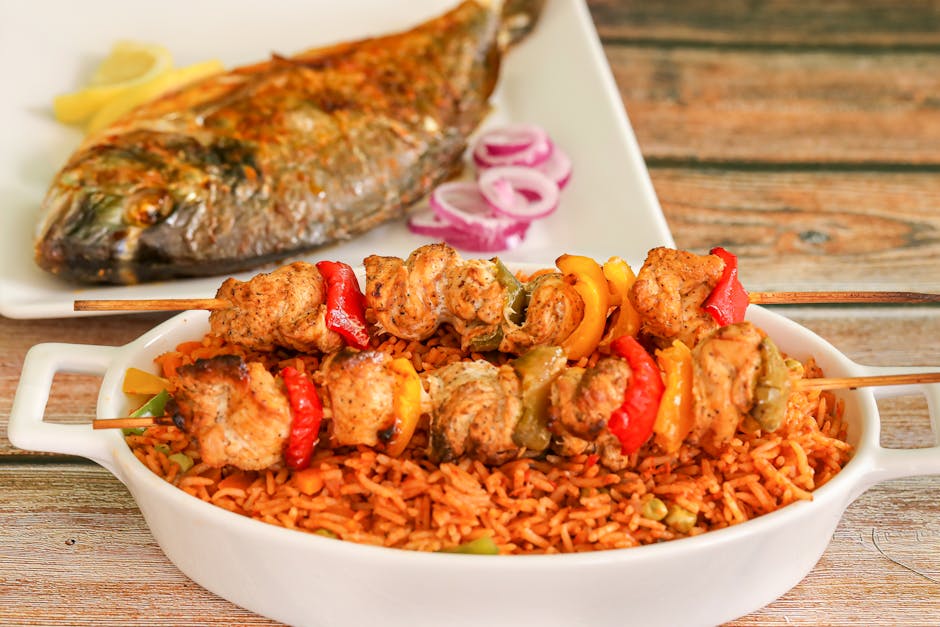
Ghanaian jollof differs from Nigerian in a way its author states plainly: the distinctive red comes from tomatoes and tomato paste, not red palm oil, and it is somewhat reminiscent of Spanish rice. Two cups of long grain white rice, not parboiled, go into a roasting pan with browned chicken and four cups of hot stock, and bake covered for fifteen to twenty minutes, then another ten to fifteen. Her own solution to the mushiness problem is the oven itself, where the heat is evenly distributed rather than only on the bottom. Stir from the outside in, because the edges brown faster.
Ingredients
Equipment: Large roaster or casserole with a lid, Heavy skillet, Oven, Wooden spoon
- 2 cups long grain white rice, not parboiled
- 4 cups water, broth or a combination — including up to a cup of drained tomato juice
- 2 lb boneless skinless chicken, cubed — or 3 lb with bones, cut small
- 2 cups fresh grated tomatoes, seeded — or 2 cups well-drained chopped, or 2 cups pureed
- 1 medium onion, finely chopped (a good cup)
- 3 good-sized cloves garlic, about 1 tbsp, minced or crushed
- 1 tbsp freshly peeled, grated ginger
- 5 tbsp (1/3 cup) tomato paste
- 1/3-1/2 cup (5-8 tbsp) peanut or other vegetable oil
- 2 tsp salt or to taste — plain, adobo or other seasoning salt
- 1 tsp curry powder, or about 1/2 tsp thyme
- About 1/2 tsp dried ground cayenne, or chopped fresh chilli
- 1 bay leaf (optional)
- 1/2 tsp black or white pepper (optional)
Vegetables, about 2-3 cups
- 1 carrot, peeled and diced
- Frozen green peas
- Bell peppers or green beans, or frozen mixed vegetables
Method
- Marinate the chicken: mix about 1/4 cup of the chopped onion with a little of the garlic and ginger, about 1/2 tsp salt, 1/8 tsp black or white pepper and 1/8 tsp red pepper.
- Heat 3 or 4 tablespoons of oil in a heavy skillet. Brown the chicken on medium-high in 2 batches, adding another 1/4 cup chopped onion and another tablespoon of oil if necessary.
- Move the chicken to a large roaster or casserole.
- Bring the 4 cups of broth, water or tomato juice to the boil with the bay leaf and keep warm.
- Preheat the oven to 350 degrees Fahrenheit, with the rack low enough for the covered pan.
- Add another 3 to 4 tablespoons of oil to the skillet with the remaining onion, garlic, ginger and the curry powder or thyme. Stir-fry a few minutes.
- Stir in the tomatoes, tomato paste, pepper and salt.
- Add the 2 cups of rice to the roasting pan with the chicken.
- Pour the hot liquid into the skillet and stir to loosen the onion, then pour it all into the roasting pan, stir well, cover and put in the oven.
- Cook covered 15 to 20 minutes. Check once for doneness and liquid, adding a little water or broth if needed. Stir the rice from the outside in, as the outside edges will brown faster than the inside.
- Return for another 10 to 15 minutes.
- Cook the vegetables separately and stir them in.
Chef Tips
- The oven is her answer to mushy jollof, and she says so directly: cooking it in the oven distributes the heat evenly rather than only on the bottom.
- Stir from the outside in. The edges of a roasting pan brown faster, and that one instruction prevents the usual unevenness.
- Long grain white, NOT parboiled. That is the opposite of the Nigerian party-jollof convention, where parboiling is the whole technique.
- What makes it Ghanaian rather than Nigerian, in her words: the red colour comes from the tomatoes and tomato paste, not from red palm oil, and it is somewhat reminiscent of Spanish rice.
- Cook the vegetables separately and stir them in at the end, or add them during the final minutes. Boiled into the rice they go to mush.
- It tastes even better the day after it is made, and it freezes nicely — her own note.
- If you cook it on the stovetop instead, beware of burning the rice on the bottom and over-stirring it into mush. That is her explicit warning.
Common Mistakes to Avoid
- Using parboiled rice.
- Stirring from the middle out, or not stirring at all.
- Adding the vegetables to the raw rice.
- Cold liquid into the pan.
- Stovetop cooking without watching the base.
Nutrition (per serving)
Health Benefits
- Tomato-led, so high in lycopene, which cooking makes more available.
- A generous separate vegetable load keeps its vitamin C.
- High in protein with the chicken.
- Gluten-free and dairy-free.
Cultural Note
The jollof argument between Ghana and Nigeria is the most enjoyable food rivalry in the world and this recipe states the Ghanaian case clearly: tomato-red rather than palm-oil-red, long grain rather than parboiled. Its author's own aside — that it is always amusing to read this called the national dish of any one country, since it belongs to the whole region — is the wisest line in the literature.
Storage & Serving
Storage: 4 days refrigerated, 3 months frozen. Better the next day, per the author.
Reheating: Steam, or microwave with a splash of water under a damp cover.
Adapted From
- Adapted from 'Recipe #20: Party-Perfect Jollof rice (with chicken)', betumiblog.blogspot.com, Thursday 15 October 2009. BYLINE AS PRINTED: 'Posted by Fran'. Quantities confirmed across two fetches (TWO-PASS). YIELD: no yield line appears in the recipe body; reader comments on one fetch have her answering 'about 10 servings', noting '2 cups rice yields 8 servings technically'. SINGLE-PASS.
- Ingredients exactly as printed: 2 cups uncooked long grain white rice (not basmati); 4 cups water or broth or a combination (including up to a cup of drained juice from tomatoes); 3 good-sized cloves of garlic (about 1 Tablespoon), minced or crushed; 2 cups fresh grated tomatoes, seeded (discard peelings) (OR 2 cups well-drained well-chopped tomatoes, OR 2 cups pureed tomatoes); 1 medium onion, finely chopped (a good cup); fresh vegetables, about 2-3 cups, such as 1 carrot peeled and diced, frozen green peas, and other vegetables such as bell peppers or green beans (OR substitute frozen mixed vegetables); 1 bay leaf (optional); 1/2 teaspoon black or white pepper (optional); 1 Tablespoon freshly peeled, grated ginger; 5 Tablespoons (1/3 cup) of tomato paste; about 1/2 teaspoon of dried ground cayenne pepper (or chopped fresh chili peppers, but be careful because the hotness may vary); 1/3 - 1/2 cup (5 - 8 Tablespoons) peanut or other vegetable oil; 2 teaspoons salt or to taste (plain or Adobo or other seasoning salt); 1 teaspoon curry powder (OR thyme, about 1/2 teaspoon); 2 pounds boneless, skinless chicken cubed, or 3 pounds with bones and cut into small pieces, breaking the bones with a heavy cleaver.
- THE MARINADE INSTRUCTION has an unclosed parenthesis as printed: 'a little (maybe 1/4 of the garlic and ginger'. Reproduced in sense above.
- THE OVEN as printed: preheat to 350 degrees 'Farenheit' — spelling as printed — with the rack low enough for the covered pan. Cook covered 15-20 minutes, check once, then another 10-15 minutes.
- THE KEY INSTRUCTION, verbatim: 'Stir the rice from the outside in as the outside edges will brown faster than the inside.'
- HER SOLUTION TO THE DISH'S MAIN FAULT, verbatim: 'The biggest problem I always used to have when making jollof rice was keeping it from becoming too mushy. I've solved that now by cooking it in the oven where the heat is evenly distributed and not just on the bottom.'
- THE STOVETOP WARNING, verbatim: 'Alternatively, this may all be cooked in a large pot on the stovetop, but beware of burning the rice on the bottom and/or stirring too often and making the rice mushy. Also, the vegetables may be added directly to the rice while it is cooking, or stirred in during the final minutes before it is done.'
- THE GHANA-VERSUS-NIGERIA CLAIM, verbatim and attributed to her rather than asserted: "Ghana's jollof rice has a distinctive red color from the tomatoes and tomato paste used, not red palm oil as versions from Nigeria might. It is somewhat reminiscent of Spanish rice." Both fetches agree. NOTE that this collection's three documented NIGERIAN jollofs do not in fact use palm oil either, so her contrast may describe some Nigerian versions rather than all.
- OTHER NOTES as printed: 'tastes even better the day after it was made, and also freezes nicely'; served 'with braised cabbage on the side and/or Ghana-style gravy, or shito'; 'Increasingly in Ghana, the rice is cooked separately with the meat... I believe this likely influenced by Western ideas of proper plating'; and 'In Ghana nowadays I cannot imagine you will be served jollof without Maggi or Royco cubes, but I prefer stock and "real" seasonings.' On crayfish, which is contested: 'the answer is yes….sometimes, Jollof rice has crayfish in it, depending on who makes it. I skip it in mine…not liking fishy rice!'
- PROVENANCE: adapted from a recipe 'developed for Penn State's Touch of Africa dinner for several hundred people in February 2009'.
- ON ORIGIN, hedged by the author and recorded as hedged: "'Jollof rice' (aka jolof or djolof or benachin)... It's always amusing to read that this is the 'national dish' of any specific West African country, since it belongs to the whole region." And: "It's sometimes credited with originating among the Wolof people of Senegal and Gambia, but is now claimed by many other West African nations, including Ghana, Nigeria, Liberia, and Sierra Leone." And: "Senegal's famous 'ceebu jen'... is a similar rice paella, but it is not the same." She adds that 'Sometimes another one-pot in Ghana, "gari foto," is called gari jollof' — see Garifoto and Pot Luck Gari Foto. Her minimum requirement: 'Be sure, however, to include tomatoes and tomato paste, onions, and rice.'
- A HISTORICAL LEAD, recorded as a lead: the earliest documented jollof recipe is reported to be in 'Practical West African Cookery' (1910) by S. Leith-Ross and G. Ruxton. 'Joloff rice' was confirmed in a dinner-menu suggestion on page 34 — 'Pumpkin soup. Joloff rice. Lime sponge.' — with the recipe itself in the book's 'Macaroni and Rice' chapter, past the point where the available text extract truncated. THE RECIPE TEXT WAS NOT RETRIEVED and nothing from it is reproduced here. That book is a manual for feeding colonial officers using African ingredients and African cooks — the earliest PRINTED jollof recipe, not the earliest one.