 Ugandan · Beverages
🥛 Obushera
Obushera — obutoko, obuteire
Malted sorghum slurry boiled two to five minutes, cooled, inoculated with germinated flour and left at ambient temperature — sweet at twelve to twenty-four hours, sour past two days.
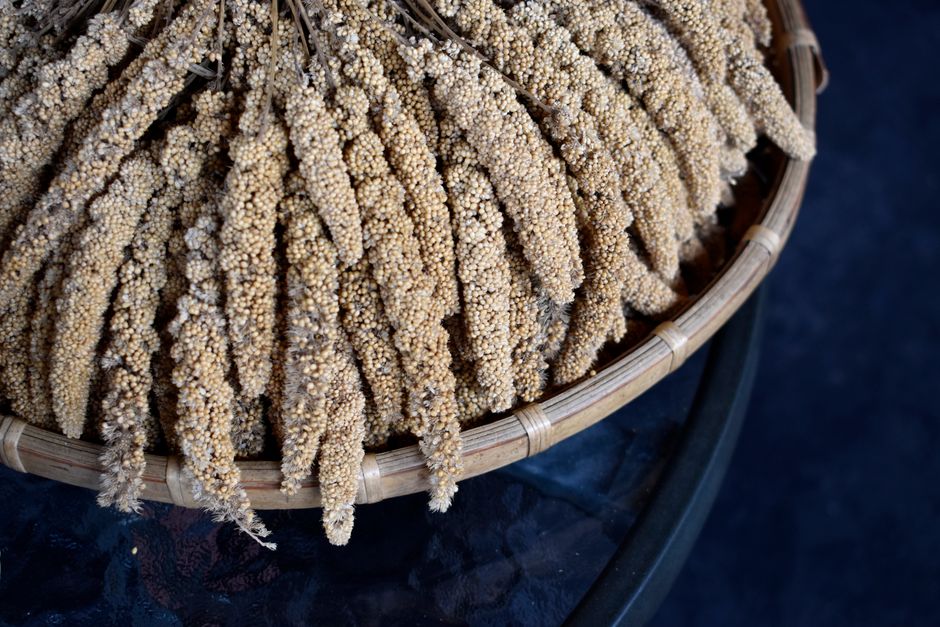
Obushera is the Bakiga's drink, called the Mukiga's milk, and it is the best-documented fermented beverage in Uganda. It has two finished states and both are correct: sweet obushera after twelve to twenty-four hours, pale brown with an intermediate viscosity; sour obushera after more than two days, slightly alcoholic at around one per cent, slightly effervescent. Ninety per cent of surveyed households drink it between two and four days. The grain is malted first with wood ash, which speeds germination and adds sweetness.
Ingredients
Equipment: Soaking vessel, Germination tray, with leaves to cover, Drying mat, Grinding stone or mill, Saucepan, Fermentation pot with a cover
The malt
- Sorghum or millet grains
- Wood ash — about one-tenth the quantity of grain
The drink
- Sorghum or millet flour
- Cooled boiled water — no traditional ratio is documented
- Germinated sorghum or millet flour, as the starter
Laboratory formulations bracket the slurry at 11 to 12.5 per cent total solids
- For reference: 50 g sorghum malt to 400 ml water
Method
Malting
- Soak the sorghum grains overnight, about 12 hours — some households go 24 to 48.
- Drain, and add wood ash at roughly one-tenth the quantity of grain, to hasten germination and increase sweetness.
- Let the grain germinate 2 to 4 days; most households use 2 to 3.
- Sun-dry the germinated grain and mill it to flour.
The slurry
- Mix flour with cooled boiled water to a paste or slurry.
- Boil it about 2 to 5 minutes.
- Let it cool.
Fermentation
- Add germinated sorghum or millet flour, or both, as the starter.
- Leave it to ferment at ambient temperature — 27 to 30 degrees.
- For sweet obushera, stop at 12 to 24 hours: sweet-tasting, pale brown, intermediate viscosity.
- For sour obushera, go beyond 2 days: slightly sour, slightly alcoholic, slightly effervescent.
- Serve.
Chef Tips
- Two finished drinks, one process. Twelve to twenty-four hours gives you sweet obushera; past two days gives you sour. Neither is a failure of the other.
- The taste is the cue and it always has been. In the laboratory the same endpoint reads as pH at or below 4.5, and starter cultures get there in ten to twelve hours where spontaneous fermentation needs twenty-four or more.
- Wood ash is a deliberate ingredient, not a contaminant. It speeds germination, increases sweetness, and is credited with the higher iron, magnesium and zinc readings in malted obushera.
- No traditional flour-to-water ratio exists in any source. The survey says only paste or slurry. The laboratory figures — 50 g of malt to 400 ml of water, or 12.5 per cent total solids — are formulations, not household practice, and are given here as a starting point rather than as tradition.
- Germination lowers the tannins and raises the sugars, which is why malted obushera is both sweeter and more nutritious.
- Four named variants are worth knowing: obutoko is fermented malted sorghum and the base for the others; ekitiribita is a thin porridge from unmalted millet, drunk within a day or two; obuteire is ekitiribita inoculated with millet malt and fermented one to four days, thicker and more pronounced; enturire is the alcoholic honey version, Enturire.
- Safety, plainly: obushera is used as an infant weaning food, and the household survey found 87 per cent of producers soaking grain in streams, rivers and ponds. Use clean water for the soak if you are making it for a child.
- Twenty-seven to thirty degrees ambient is what the survey recorded. In a cooler kitchen it will simply take longer.
Common Mistakes to Avoid
- Treating the sour version as spoiled.
- Skipping the wood ash in the malting.
- Adding the starter while the slurry is still hot, which kills it.
- Boiling the slurry for much longer than five minutes.
- Fermenting in a refrigerator, which stops it.
Nutrition (per serving)
Health Benefits
- Lactic fermentation makes the iron and zinc considerably more available.
- Sorghum and millet are both naturally gluten-free and high in minerals.
- Malting lowers the tannins, which otherwise bind minerals.
- Used as a weaning food and a daily drink, so hygiene in the water and vessels matters.
Cultural Note
Obushera originates in western Uganda and is drunk across the west, south-west and centre, but it is the Bakiga of Kigezi it belongs to most — the Daily Monitor called it the Mukiga's milk, which says exactly how it is regarded. It turns up at social gatherings and ceremonies, as an everyday drink, and as a weaning food, which is an unusually wide range for one preparation.
Storage & Serving
Storage: It keeps fermenting. Sweet obushera holds a day; the sour version keeps several.
Reheating: Drunk at ambient temperature, not heated.
Serve with: Karo, Empengyere, Roasted Simsim
Adapted From
- Adapted from C. Muyanja and J. Kikafunda, 'Production Methods and Composition of Bushera: A Ugandan Traditional Fermented Cereal Beverage', African Journal of Food, Agriculture, Nutrition and Development — a household survey across Kabale and Rukungiri districts. The 12-hour overnight soak with its 24-to-48-hour variation, the wood ash at approximately one-tenth of the grain, the 2-to-4-day germination, the 2-to-5-minute boil reported by 90 per cent of households, the 27-to-30-degree ambient fermentation, the 12-to-24-hour sweet and beyond-2-day sour split, the sensory descriptions of each, the 1.03 per cent alcohol in the sour version and the finding that 87 per cent of households soak grain in streams, rivers and ponds are all from that survey.
- The laboratory formulations are from Ivan Muzira Mukisa and A. Byaruhanga at Makerere University — 50 g of sorghum malt in 400 ml of water, heated to 90 degrees for 10 minutes and cooled to 30 before inoculation, reaching pH 3.50 to 4.13 within 12 hours with starters — and from a related Research Square preprint giving a 12.5 per cent total-solids slurry and a stated target of pH at or below 4.5. These are laboratory formulations, not documented household practice, and are labelled as such.
- The four named variants obutoko, ekitiribita, obuteire and enturire are documented from Mukisa et al. 2012 and Byakika et al. 2019.
- The weaning-food use is documented; Byakika et al. 2019 on the microbiological quality and food-safety knowledge of obushera producers is the paper to read before making it for a child.
- FAO's 'Sorghum and millets in human nutrition' describes the method but gives no quantities, times, temperatures or pH, and is cited only for that description. Its recipe annex carries no bushera recipe at all.