 Ghanaian · Street Food & Snacks
🍩 Bofrot
Bofrot — togbei, puff-puff
The chewy yeast-risen version, where palm wine is traditional — it should at least double in size, so make sure your bowl is large enough.
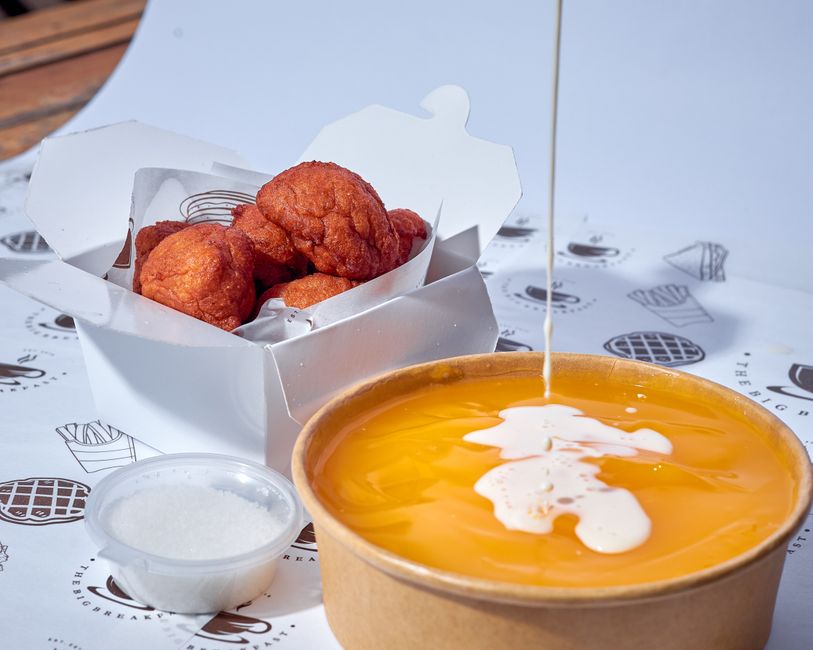
The Ghanaian doughnut, called bofrot in Twi and togbei in Ga, which delightfully means goat's balls. The traditional riser is palm wine from the oil palm; this is a diaspora formula substituting yeast and a little dry white wine for it, and the author says so openly. The yeast is softened in warm water and sugar until it begins to bubble, a third of a beaten egg goes in, then bread flour, nutmeg, a pinch of baking powder and salt. It sits somewhere warm for at least two hours and should at least double in size. Fried at 375, the balls are done when they are quite dark — probably darker than you would think.
Ingredients
Equipment: Large bowl — big enough for the dough to double, Cloth, to cover, Deep fryer or large heavy pot, Soup spoon, Paper-towel-lined colander
- 1/3 cup warm water — or 1/2 cup if you are not using wine
- 1.5 oz sugar — 3 tbsp plus 1 tsp
- 1.25 oz dry white wine or water — 3 tbsp if using wine. See the note on this figure
- 1/3 egg — beat a large egg, pour it into a 1/4 cup measure and pour out a third
- 1 tsp yeast
- 4 oz bread flour, higher gluten than regular white flour — about 1/2 cup plus 1/3 cup unsifted
- 1/4 tsp ground nutmeg
- 1/8 tsp baking powder
- Pinch of salt
- Oil for deep frying
Traditionally: palm wine in place of the yeast and white wine.
The oldest recipes call for currants; a more recent one calls for raisins.
Method
- Measure the liquid into a bowl and stir in the sugar to dissolve.
- Sprinkle the yeast over to soften. Let it sit for a few minutes to allow the mixture to begin to bubble.
- Meanwhile measure the flour and have the nutmeg, baking powder and salt ready.
- Beat an egg and measure a third of it in a 1/4 cup measuring cup.
- Once the yeast begins to foam, add the egg and mix it with the liquids.
- Gradually sift and stir in the flour, adding the nutmeg, baking powder and pinch of salt.
- Mix all together well, cover the bowl with a cloth and allow it to sit in a warm place for at least 2 hours.
- It should at least double in size by then, so make sure your bowl is large enough to accommodate the dough.
- Heat the oil to 375 degrees in a deep fryer or large heavy pot, filling it no more than halfway.
- Line a colander with paper towels.
- Dip a soup spoon in the oil first, then scoop the batter and drop it into the oil as a ball.
- If the balls flatten out, there is likely too much liquid in your batter. If they sink to the bottom, your oil is not hot enough. If they brown on the outside but do not cook on the inside, your oil is too hot.
- Turn the balls as needed to cook evenly.
- When they are quite dark, probably darker than you would think they need to be, remove them to drain in the paper-towel-lined colander.
- Enjoy them warm or at room temperature.
Chef Tips
- At least double in size is the rise cue, and the two hours is a minimum rather than a target. Judge by the dough, not the clock, and use a bowl with room.
- The yeast must visibly bubble and foam before the egg goes in. That is the second cue and it tells you the yeast is alive.
- Three oil diagnostics in one recipe, all observable: flattening means too much liquid in the batter; sinking means the oil is too cool; browning outside while raw inside means too hot.
- Quite dark, probably darker than you would think. Pale bofrot are raw in the middle — this is the most common failure.
- Dip the spoon in the oil before the batter. The batter slides off a greased spoon in a ball instead of clinging.
- Palm wine is the traditional riser and gives it a distinctive taste. Yeast plus a little dry white wine is this author's substitution for a kitchen with no palm wine, and she presents it as such.
- This is a deliberately small batch and can be doubled, tripled or quadrupled. Make the small one the first time.
- In Ghana experienced cooks scoop the batter in the hollow of the right hand and drop it in a perfect ball. The spoon is the beginner's method.
Common Mistakes to Avoid
- Pulling them out while still golden rather than quite dark.
- A bowl too small for the dough to double.
- Adding the egg before the yeast foams.
- Dropping batter from a dry spoon.
- Oil too cool, so they sink and soak.
Nutrition (per serving)
Health Benefits
- Bread flour's higher gluten gives more protein than a cake flour.
- Egg contributes complete protein and choline.
- Nutmeg carries antioxidant compounds.
- A small batch by design, which is its own portion control.
Cultural Note
Bofrot is sold from glass cases on Ghanaian street corners, eaten with hausa koko for breakfast, and handed out at every church gathering. That the Ga name means goat's balls is the kind of fact a cook remembers from Nungua in the 1970s and writes down, and the palm-wine original is a reminder that West African baking was fermenting dough long before commercial yeast arrived.
Storage & Serving
Storage: Best the day they are made. 2 days in an airtight container.
Reheating: A hot oven briefly. The microwave makes them tough.
Serve with: Sobolo, Hausa Koko, Bissap
Adapted From
- Adapted from 'Recipe #28A: Bofrot, togbei, puff-puff (African donuts), yeast version', betumiblog.blogspot.com, Thursday 12 November 2009, 7:28 PM. BYLINE AS PRINTED: 'Posted by Fran'. Quantities confirmed across two fetches, with two further targeted verification passes on the frying tests — four fetches in all (TWO-PASS).
- THE FERMENTATION RULE IS SATISFIED, which is why this publishes. THE RISE CUE, verbatim: 'It should at least double in size by then, so make sure your bowl is large enough to accommodate the dough.' AND THE YEAST-ACTIVITY CUE, verbatim: 'Let it sit for a few minutes to allow the mixture to begin to bubble' and 'Once the yeast begins to foam, add the egg and mix it with the liquids'. The elapsed figure is written as a minimum — 'at least 2 hours' — which makes the doubling the operative test rather than the clock. This collection does not publish a fermented or risen preparation on a bare time figure; here there are two observable endpoints.
- Ingredients exactly as printed: '1/3 cup warm water'; '1.5 oz sugar (3 Tablespoons plus 1 teaspoon)'; '1.25 oz dry white wine or water (If using white wine, 3 Tablespoons--if not using wine, increase the 1/3 c warm water above to 1/2 cup)'; '1/3 egg (I beat a large egg, poured it in a 1/4 cup measuring cup, then poured out 1/3 of it)'; '1 teaspoon yeast (I happened to have rapid rise yeast, so used that)'; '4 oz of bread flour (higher gluten content than regular white flour) [that's about 1/2 c plus 1/3 cup unsifted flour]'; '1/4 teaspoon ground nutmeg'; '1/8 t baking powder'; 'pinch of salt'; 'oil for deepfrying (I used canola)'.
- A MISPRINT FLAGGED AND NOT CORRECTED: '1.25 oz dry white wine or water' is paired with '3 Tablespoons', but 3 tablespoons is 1.5 fluid ounces, not 1.25. Both figures were returned identically on both passes, so the inconsistency is in the source rather than in retrieval. Neither figure is adjusted toward the other.
- ON '1/3 EGG': printed as such, with the author's own method for measuring it. It follows from this being deliberately a small batch and is not a misprint.
- BOTH YEAST AND A LITTLE BAKING POWDER are present, as printed. That is not an error — the baking powder is an eighth of a teaspoon alongside a full teaspoon of yeast.
- THE OIL DIAGNOSTIC, verbatim and confirmed against this page on two separate passes so that it is not confused with the cake version's: 'If the balls flatten out, there's likely too much liquid in your batter. If they sink to the bottom, your oil is not hot enough, and if they brown on the outside but do not cook on the inside, your oil is too hot.'
- THE FRY-DONENESS CUE, verbatim: 'When they are quite dark, probably darker than you would think they need to be, remove them to drain in a paper-towel-lined colander.' NO FRY TIME IN MINUTES IS PRINTED anywhere on this page; doneness is by colour alone. A retrieval pass that offered a minute figure was a fabrication and is not published.
- OIL TEMPERATURE as printed: '375 degrees', with NO unit printed on this page — unlike the companion cake version and the atwemo post, both of which print Fahrenheit. Read as Fahrenheit on that basis, and the ambiguity is recorded.
- ON PALM WINE, the traditional riser, quoted: 'Palm wine (from the oil palm Elaeis guineensis) in place of yeast' and 'The palm wine gives it a distinctive taste'. The author substitutes yeast and dry white wine because palm wine was unavailable to her. THIS ENTRY IS THEREFORE A DOCUMENTED DIASPORA SUBSTITUTION FOR A PALM-WINE FERMENT, not the palm-wine original. Note that this collection separately documents palm wine's own fermented products, pito and burukutu, at Pito and Burukutu.
- ON THE NAME, quoted: the author lived in Nungua in the 1970s and found 'a fried sweet dough that the Ga people call togbei, which, delightfully, means "goat's balls."' The Akan name bofrot is pronounced approximately 'boff-row'.
- ON CURRANTS, quoted with the author's own uncertainty intact: 'The oldest recipes I've seen call for using currants (and a more recent one calls for raisins), but I do not recall ever having tasted them made that way, and wonder if it is a Ghanaian regional variation or is more common in Nigeria, as bofrot appears to be the same dish as Nigerian "puff-puff."' Note that this collection documents Nigerian puff puff separately, and it is indeed the same dish.
- ON THE GHANAIAN HAND METHOD, quoted: 'In Ghana, experienced chefs efficiently and quickly scoop up the batter in the hollow of their right hand and drop it into the oil in a perfect ball.'
- NO YIELD IS PRINTED. What is printed is a scaling statement: 'Here is my recipe for the traditional chewy type (this can be doubled, tripled, quadrupled, etc. to make large batches). I suggest making the small recipe the first time.' The six servings above is editorial and a scaling statement is not stored as a yield.
- THE COMPANION POST, published the next day, is the baking-powder cake version at Bofrot Cake Version. The two are explicitly a pair.