 Nigerian · Street Food & Snacks
🥓 Kilishi
Kilishi — kilichi
Sheets sliced to about 0.5 cm, sun-dried to 40–50 per cent moisture, soaked in a groundnut-cake labu, dried again to 20–30 per cent and roasted five minutes.
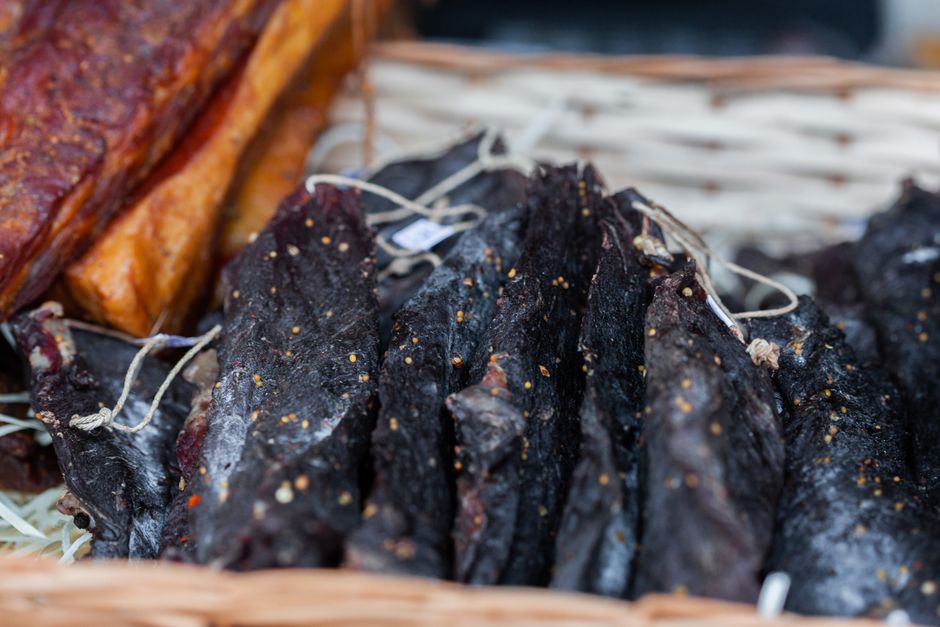
Kilishi is the north's dried spiced meat and it is a four-stage process with moisture targets at every stage. Thin sheets — about half a centimetre thick, fifteen long, up to six wide — are sun-dried two to six hours down to forty or fifty per cent moisture. They are then soaked in labu, a paste of defatted groundnut cake, water, garlic, bouillon, salt and spices, dried again for two to three hours to twenty or thirty per cent, and roasted about five minutes over a glowing fire to ten or twelve per cent. Sealed, it keeps about a year at room temperature.
Ingredients
Equipment: Very sharp knife, Drying racks or mats, Large bowl, for the labu, Charcoal grill or glowing fire, Low-density plastic bags for sealing
- Beef, in thin sheets about 0.5 cm thick, 15 cm long and up to 6 cm wide
Labu marinade, by proportion of the paste
- Defatted groundnut cake paste, about 50%
- Water, 30%
- Garlic, 10%
- Bouillon cubes, 5%
- Salt, 2%
- Spices — pepper, ginger, onion, unquantified
Method
- Slice the beef into thin sheets, about 0.5 cm thick, 15 cm in length and as much as 6 cm wide.
- Sun-dry the sheets two to six hours, reducing the moisture to 40 to 50 per cent.
- Make the labu: combine the defatted groundnut cake paste with water, garlic, bouillon cubes, salt and the spices, to a thick but spreadable paste.
- Soak or coat the dried sheets thoroughly in the labu.
- Dry again two to three hours, down to 20 to 30 per cent moisture.
- Roast about five minutes over a glowing fire, taking the moisture to 10 to 12 per cent.
- Cool completely, then pack in hermetically sealed, low-density plastic bags.
Chef Tips
- Sun-dry BEFORE marinating, not after. All three sources that sun-dry at all agree on this sequence, and it is what lets the labu soak into partly dried meat rather than sitting on wet meat.
- Half a centimetre is the thickness to cut to, and the sheets should be wide and long rather than strip-shaped. Getting them even is the hardest part of the whole process.
- The labu proportions are the only quantified formulation available: about half groundnut cake paste, a third water, a tenth garlic, a twentieth bouillon, two per cent salt. The spices on top of that are not quantified anywhere.
- Defatted groundnut cake, not peanut butter. The fat has to be out or it will not dry.
- Five minutes roasting, and watch it. By this point the meat is nearly dry and burns in moments.
- Sealed in low-density plastic bags it is stable at room temperature for about a year, which is the whole point of the technique.
- On thickness, be aware the published figures disagree wildly — 0.5 cm here, 3 mm in the oven version, and 20 mm in one Kano field survey. Twenty millimetres is not a thin sheet by any reading and is treated here as a probable unit error, but it is what that paper prints.
Common Mistakes to Avoid
- Marinating before the first drying.
- Cutting strips instead of sheets.
- Using full-fat groundnut paste, which prevents proper drying.
- Roasting longer than five minutes.
- Bagging it before it has cooled completely.
Nutrition (per serving)
Health Benefits
- Very high in protein for its weight, and very low in carbohydrate.
- Defatted groundnut cake adds protein rather than fat.
- No refrigeration needed, which is the point of the preservation.
- Lean beef supplies iron, zinc and B12.
Cultural Note
Kilishi is a genuine preservation technology, not just a snack — four controlled drying and roasting stages taking the meat from fresh to ten per cent moisture, stable for a year without refrigeration in a hot climate. Kano is the centre of production and the Agadasawa are named as its key producers. Sweet, salty and nutty varieties exist, with honey or tiger nuts in the labu.
Storage & Serving
Storage: About a year at room temperature in hermetically sealed bags, per the source.
Reheating: Eat as is. A few seconds over heat refreshes the aroma.
Serve with: Yaji, Cold beer or stout, Hot tea
Adapted From
- Process adapted from 'The Art, Science & Beauty of Kilishi', published on kitchenbutterfly.com. ATTRIBUTION: the byline prints as the site name; the site is credited, with Ozoz Sokoh noted as proprietor. Figures as printed there: slicing 'thin slices of meat…about 0.5 cm thickness, 15 cm length and as much as 6 cm width'; first sun-dry 'two to six hours', reducing moisture to '40 to 50 percent'; second dry after marinating 'two to three hours' to '20 to 30 percent'; roasting 'about five minutes' over glowing fire to final moisture '10 to 12 percent'; shelf life 'remains remarkably stable at room temperature for a period of about one year' when 'packaged in hermetically sealed, low density plastic bags'.
- THE LABU FORMULATION, which that page attributes to FAO and is the ONLY quantified labu formulation found anywhere: defatted groundnut cake paste ~50%; water 30%; garlic 10%; bouillon cubes 5%; salt 2%; spices — pepper, ginger, onion — unquantified. Note this is secondhand: the page is citing FAO rather than measuring, and it says explicitly that no quantities are given for the traditional seasoning blend beyond those FAO percentages.
- CORROBORATING FIELD SURVEY: Igwe, E.C., Abdullahi, N., Abusalam, N., Dandago, M.A., & Obiegbuna, E.J. (2015), 'Evaluation of Production Techniques and Quality Assessment of Kilishi in some parts of Kano, Kano state, Nigeria', International Journal of Basic Science and Technology, 1(1), 35–38. It gives: ingredients 'groundnut cake, water, bouillon cubes, salt, garlic and spices such as pepper, ginger and onion' with NO proportions or percentages; first sun-dry '5 - 10 hours depending on the humidity, temperature and air flow'; second dry '2 - 4 hours depending on the drying conditions'; roasting 'roasted over a glowing fire for 4 - 5minutes'. Infusion time not specified, temperature not documented, and no fresh-to-dried yield ratio provided.
- THE THICKNESS DISAGREEMENT, reported and NOT reconciled. Kitchen Butterfly: 'about 0.5 cm' (5 mm). Igwe et al.: 'thin slicing of the meat to flat thin sheet of about 20mm thickness'. All Nigerian Recipes: 'as thin as 3mm' (Kilishi, Oven Method). Michael Bamidele in The Guardian: 'very thin fillets', unquantified. Igwe et al.'s 20 mm is four times Kitchen Butterfly's 5 mm and roughly seven times All Nigerian Recipes' 3 mm, and 20 mm is not a thin sheet by any ordinary reading. It is treated here as a probable unit error in the published paper, the 0.5 cm is used because the 3 mm figure corroborates it in spirit, and the paper's divergence is recorded rather than silently dropped.
- FIRST SUN-DRY ALSO DISAGREES: 2 to 6 hours (Kitchen Butterfly), 5 to 10 hours (Igwe et al.), at least 6 hours (Bamidele, Guardian). Roasting is the one point of near-agreement: about 5 minutes and 4 to 5 minutes.
- ETHNOGRAPHY from the same site's 'The Arewa Kitchen: Specialty Meats (or Suya Plus)', with no quantities: the labu paste is 'made from peanuts called "Labu"' with water, spices, salt, ground onions and sweeteners such as honey; KANO'S AGADASAWA PEOPLE are named as key producers; varieties are sweet (honey), salty, and nutty (peanuts or tiger nuts).
- A FOURTH SOURCE NOT USED FOR QUANTITIES, and why: 'How To Make Kilishi (Nigerian Beef Jerky)', byline Michael Bamidele, Guardian Nigeria, prints an ingredient list with three unusable defects — 'tspn cloves powder 1/2' with the quantity trailing the ingredient, '1/2 paprika' with no unit at all, and 'Spices' as an ingredient line with no identity and no quantity. Those are reproduced here as source defects rather than guessed at, and that list is not used. Its one usable contribution is the order of operations, which matches: it sun-dries 'for at least 6 hours' before marinating.