 South African · Bread
🍥 Ujeqe
Ujeqe
The Zulu steamed bread — a faintly sweet buttered dough proved twice, then steamed in a covered bowl over a pot until it comes out pale, soft and entirely crustless.
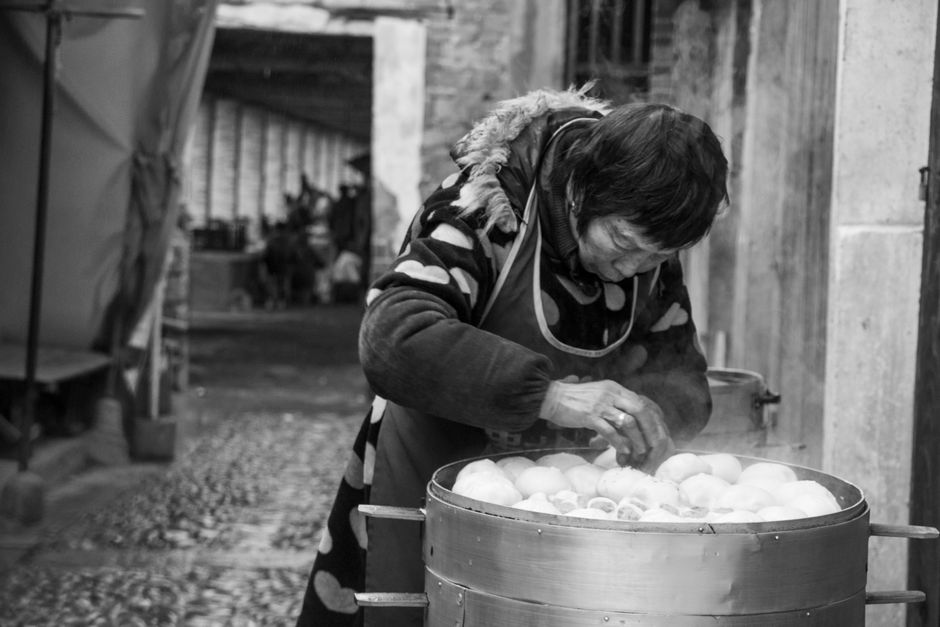
Ujeqe is what a Zulu household serves with anything that has gravy, and its appeal is the contrast: slightly sweet bread against savoury beans or tripe. It is proved twice, which is what gives it the fine, even crumb, and steamed rather than baked, which is why it has no crust to get in the way. Wrapped in maize leaves it becomes ujeqe wombila, which is how it was made before enamel bowls.
Ingredients
Equipment: Large mixing bowl, Greased heatproof bowl that fits inside your largest pot, Aluminium foil, Oven mitts
- 1 kg cake flour
- 2 tsp salt
- 590 ml (2 1/2 cups) lukewarm water
- 2 tbsp sugar
- 10 g sachet dry active yeast
- 30 g butter, melted
For steaming
- 1.4 L (6 cups) water, for the pot
Method
- Mix the flour and salt together in a large bowl.
- In a separate bowl, mix the lukewarm water, sugar and yeast. Cover and leave about 15 minutes, until the yeast has started to rise and foam.
- Whisk the melted butter into the yeast mixture, then add the dry ingredients slowly and mix to a stiff dough.
- Knead for 8 to 10 minutes, until smooth.
- Put the dough into a greased heatproof bowl and leave it to rise until doubled.
- Knock it down, return it to the greased bowl and let it rise until doubled a second time.
- Pour the 6 cups of water into your largest pot and stand the bowl of dough in it. Cover the pot tightly with foil, sealing the edges.
- Bring the water to the boil and steam for 40 to 50 minutes, checking that the pot has not boiled dry. The bread is done when a skewer comes out clean.
- Lift the bowl out with oven mitts, cool slightly, turn out, slice thickly and serve warm.
Chef Tips
- Prove it twice. The second rise after knocking down is what gives ujeqe its close, even crumb rather than an open bready one.
- Grease the bowl properly. A steamed loaf that sticks tears coming out and you lose the top.
- The steaming time depends on the width of your bowl — a tall narrow bowl takes closer to 50 minutes, a shallow wide one nearer 40. Test with a skewer rather than the clock.
- Sliced thick and buttered while still warm, it needs nothing else. Sliced thin it falls apart.
Common Mistakes to Avoid
- Only proving once, which gives a coarse, uneven loaf.
- A loose foil seal, letting the steam escape and leaving a wet centre.
- Letting the pot boil dry, which both burns the pan and stops the bread cooking.
- Cutting into it straight from the pot — it needs a few minutes to set or it squashes under the knife.
Nutrition (per serving)
Health Benefits
- Steamed, so it needs no fat beyond the butter in the dough.
- Filling enough to turn a small amount of stew into a full meal.
- Lower in fat than a baked enriched bread.
Cultural Note
Ujeqe belongs with the dishes it is served alongside — usu, amanqina, beans — and in Zulu custom those dishes were distributed by household role, tripe and dumpling to the women and girls, trotters to the unmarried men. The bread was the one thing everyone got.
Storage & Serving
Storage: Wrapped, at room temperature 2 days. Freezes well, sliced, for a month.
Reheating: Steam slices briefly, or warm them in a dry pan.
Serve with: Iimbotyi, Amanqina, Istambu namathambo