 South African · Street Food & Snacks
🍞 Vetkoek
Vetkoek — amagwinya, magwinya
A wet, lightly sweetened yeast dough rolled into balls and deep-fried with the lid on until they float — sold on every street corner in the country under three different names.
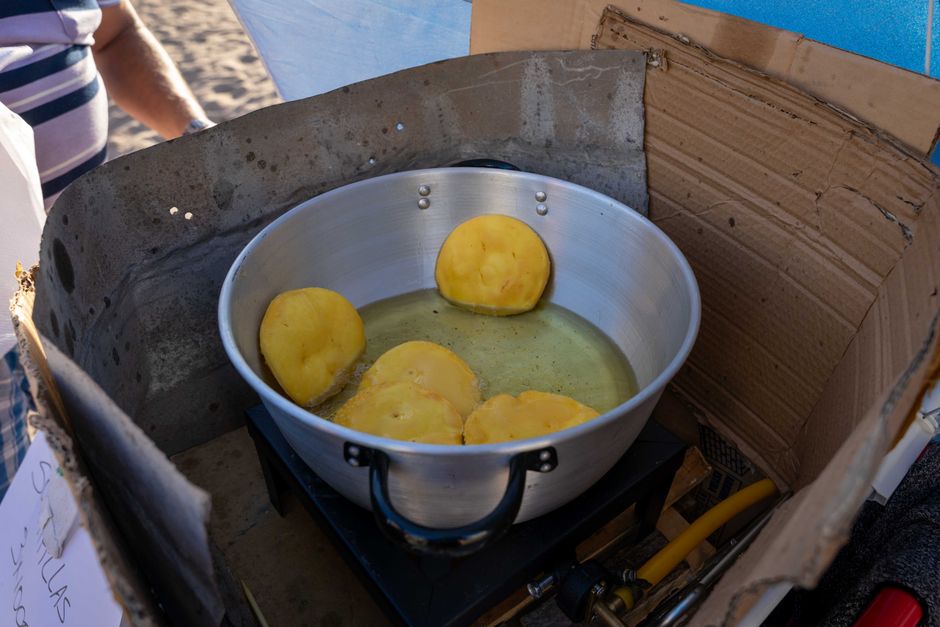
Vetkoek in Afrikaans, amagwinya in isiZulu and isiXhosa, magwinya in Sesotho: the same fried dough, and one of very few South African foods that genuinely belongs to everybody. It is breakfast from a street stall, split and filled with curried mince or polony or apricot jam, and it is also a dinner at home. The dough is deliberately wet — a litre of water to a kilo of flour, and the recipe expects you to add more, not less.
Ingredients
Equipment: Large mixing bowl, Deep heavy saucepan with a lid, Floured tray, Slotted spoon
- 1 kg flour, plus extra for dusting
- 120 g sugar
- 1 x 10 g sachet instant yeast
- 2 tbsp oil
- 1 tbsp salt
- 1 L warm water, plus up to 1 cup more if the dough is stiff
- Vegetable oil, for deep-frying
Method
- Mix the flour, sugar, yeast, oil, salt and warm water together, adding the extra water only if the dough is too stiff to work.
- Knead thoroughly, then prove for 30 minutes until well risen — longer on a cold day.
- Dust a tray with flour. Scoop handfuls of dough, roll them into balls and set them on the tray.
- Leave the balls to rise until doubled.
- Heat the oil in a deep saucepan to about 180C — hot enough that a scrap of dough rises and colours within seconds, but not smoking.
- Fry a few at a time: lower the balls in and cover the pan with a lid.
- Check after about 10 minutes — they should have risen to the top of the oil. Turn them to brown the other side.
- Drain on kitchen paper and serve hot.
Chef Tips
- The lid is the unusual part and it works: it traps steam so the inside cooks through while the outside browns slowly.
- Keep the balls a manageable size. Large ones stay raw in the middle even after ten minutes a side.
- Split and filled with curried mince is the street-corner standard, and the one most South Africans mean. Sweet, with apricot jam or syrup, is the home version.
- The dough is meant to be wet. Firming it up with extra flour gives dense, heavy vetkoek.
- Fry them in small batches. Crowding the pan drops the oil temperature and they soak it up.
Common Mistakes to Avoid
- Making the dough too stiff, which is the commonest reason they come out heavy.
- Frying in oil that is not hot enough, so they absorb it instead of sealing.
- Frying in oil that is too hot, which browns the outside long before the middle has cooked.
- Rolling them too big, so the centre stays raw.
Nutrition (per serving)
Health Benefits
- Dairy-free and egg-free, so entirely plant-based as written.
- Filling and cheap — a kilo of flour makes twelve.
- Lightly sweetened at 120 g of sugar per kilo of flour, which is modest for a fried dough.
Cultural Note
That this dish has three names in three languages and is claimed by none of them exclusively says something worth noticing. Amagwinya are sold at taxi ranks and school gates, and the trade is overwhelmingly run by women — one of the most widespread informal food businesses in the country.
Storage & Serving
Storage: Best the day they are made. Keep a day in a paper bag; freeze for a month.
Reheating: Warm in a hot oven for 5 minutes to bring back the crust.
Serve with: Curried mince, Apricot jam, Fresh green salad